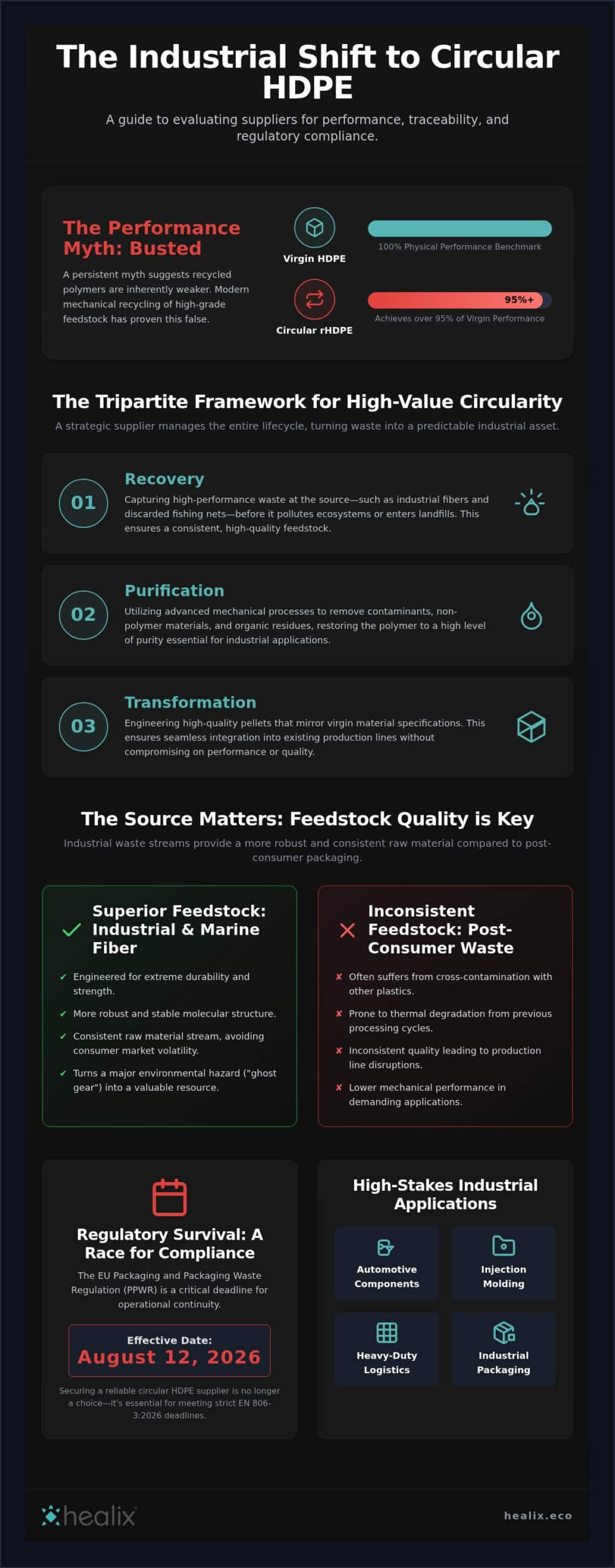
Properly processed rHDPE can achieve over 95% of the physical performance of virgin HDPE, yet many industrial supply chains still treat recycled feedstock as a compromise rather than a strategic asset. You recognize that the pressure to transition is no longer a choice. It’s a mandate. With the EU Packaging and Packaging Waste Regulation (PPWR) taking effect on August 12, 2026, the search for a reliable circular HDPE supplier has become a race for regulatory survival and operational continuity. You need resins that don’t fail during high-pressure testing or suffer from the mechanical inconsistencies that plague low-tier recycled batches.
This guide empowers you to evaluate potential partners based on material performance, certified traceability, and the rigorous transformation of industrial waste into high-quality resins. We’ll explore a tripartite framework for securing a consistent supply of industrial-grade pellets, obtaining the necessary documentation for global sustainability reporting, and successfully integrating circular materials into your existing production lines. By shifting from simple recycling to a model of recovery, purification, and engineering, you can protect your supply chain from disruption while meeting the strict EN 806-3:2026 compliance deadlines.
Key Takeaways
- Identify the essential criteria for selecting a circular HDPE supplier that acts as a strategic lifecycle partner, ensuring your materials meet the highest industrial standards.
- Master the technical benchmarks of high-quality recycled pellets, specifically focusing on Melt Flow Index and tensile strength to maintain production efficiency without compromise.
- Establish a rigorous verification framework using global certifications to guarantee a transparent chain of custody and secure the documentation required for sustainability reporting.
- Explore the industrial versatility of circular resins across complex applications, including automotive components, injection molding processes, and heavy-duty logistics solutions.
- Understand how to scale your circular transition through advanced mechanical recycling that transforms discarded marine and agricultural fiber waste into high-performance raw materials.
The Strategic Role of a Circular HDPE Supplier in Modern Manufacturing
The global plastic crisis demands more than just traditional recycling. It requires a systemic overhaul. A true circular HDPE supplier isn’t just a middleman selling scrap; they’re a strategic partner managing the entire lifecycle from the recovery of discarded materials to the precision engineering of new resins. This shift is vital as we approach August 12, 2026, when the EU Packaging and Packaging Waste Regulation (PPWR) mandates higher recyclability and producer responsibility. Manufacturers can no longer rely on simple downcycling, where plastic is degraded into lower-value products. Instead, they must embrace high-value circularity that restores the material’s integrity for demanding industrial use.
To achieve this level of performance, a supplier must master three distinct phases:
- Recovery: Capturing high-performance waste at the source before it enters ecosystems or landfills.
- Purification: Utilizing advanced mechanical processes to remove contaminants and restore polymer purity.
- Transformation: Engineering high-quality pellets that mirror virgin specifications for seamless integration.
This methodology ensures that every batch of resin performs predictably, protecting your production lines from the risks of inconsistent feedstock.
Bridging the Gap Between Waste and Raw Material
Manufacturers face a volatile market for recycled feedstock. A circular HDPE supplier stabilizes this supply chain by focusing on “difficult” feedstock like industrial fibers and fishing nets. These materials, often called “ghost gear,” are a massive environmental threat. By intercepting these nets, suppliers turn a planetary hazard into a predictable industrial resource. This process cleans the oceans and provides a consistent raw material stream that bypasses the instability of consumer waste. To understand the full transformation process behind recycled fishing gear raw materials and how ghost gear is re-engineered into certified industrial polymers, it’s essential to examine each phase from collection through pelletization.
Virgin vs. Circular: The Performance Evolution
A persistent myth suggests that recycled polymers are inherently weaker than virgin counterparts. This is no longer true for industrial-grade resins. High-density polyethylene (HDPE) is valued for its strength, and modern mechanical recycling preserves these properties through multiple lifecycles. When you select a supplier, look for an industrial-grade resin that meets global standards for tensile strength. True circularity ensures pellets are ready for high-stakes applications in automotive parts and industrial packaging.
Technical Specifications: Evaluating Pellet Performance and Quality
Precision is the bedrock of systemic circularity. When you evaluate a circular HDPE supplier, you aren’t just purchasing material; you’re investing in a technical specification that must withstand the rigors of industrial production. The mechanical properties, specifically Melt Flow Index (MFI), density, and tensile strength, must align with your existing machinery requirements. Research indicates that properly processed rHDPE can achieve over 95% of the physical performance of virgin HDPE for most industrial applications. This level of integrity is only possible through advanced mechanical recycling that targets and removes contaminants at a molecular level.
Achieving this level of integrity requires a focus on three technical pillars:
- Purification: Removing non-polymer contaminants and organic residues.
- Stabilization: Ensuring the polymer chains remain robust during re-processing.
- Verification: Utilizing continuous spectral analysis to guarantee batch uniformity.
Unlike post-consumer bottles, which often suffer from cross-contamination and thermal degradation, circular HDPE derived from industrial nets and ropes offers a more robust molecular structure. These marine fibers were originally engineered for extreme durability. Their recovery yields a resin that maintains high tensile strength, making it ideal for the demanding requirements of automotive parts and heavy-duty pallets. If you’re looking to upgrade your feedstock, you can explore certified circular plastic solutions that meet these exact industrial benchmarks. Before making that transition, it’s worth understanding how marine plastic raw materials debunk common myths about performance and contamination risks that may be holding your procurement team back.
Purification and Deodorization Processes
Purity is non-negotiable for sectors like automotive or consumer packaging where odors and volatile organic compounds (VOCs) can compromise the final product. Advanced suppliers utilize double degassing systems to eliminate VOCs during the extrusion process. This ensures that the resulting pellets are not just structurally sound but also chemically clean. Melt filtration acts as the final barrier against microscopic impurities, ensuring that only pure polymer passes through the die. For manufacturers who need to specify exact density and Melt Flow Index parameters, the technical framework for sourcing high-purity recycled plastic pellets that meet rigorous industrial polymer specifications provides a comprehensive benchmark for evaluating supplier capabilities.
Consistency Across Production Batches
Industrial manufacturing demands batch-to-batch uniformity. A supplier’s role is to minimize the variance that often plagues recycled materials. Robust internal quality control involves continuous resin testing to verify that every lot meets the agreed-upon technical datasheet. For those focused on specific container requirements, it’s helpful to consult the Recycled HDPE Packaging: Circular Material Guide to understand how these specs translate to shelf-ready products. By prioritizing consistency, you protect your production lines from the downtime caused by unpredictable material behavior.
Traceability and Certification: The Supplier Verification Framework
Trust in the circular economy is built on data, not promises. Procurement is no longer a simple transaction; it’s a rigorous audit of ecological integrity. A circular HDPE supplier must provide more than just a technical datasheet. They must offer a verifiable map of the material’s journey. This transparency is achieved through a robust Chain of Custody (CoC) that links a discarded fishing net in the North Sea directly to the high-quality pellets on your factory floor. Without this link, “ocean-bound” claims are merely marketing narratives vulnerable to regulatory scrutiny.
To secure your supply chain and satisfy stakeholders, you must demand a tripartite verification framework:
- Global Standards: Look for Global Recycled Standard (GRS) or ISCC PLUS certifications to verify recycled content percentages.
- Chemical Safety: Ensure full REACH and RoHS compliance to guarantee the absence of hazardous substances in the resin.
- Environmental Impact: Require Life Cycle Assessment (LCA) data to quantify the carbon footprint reduction compared to virgin HDPE.
These certifications aren’t optional. They are the ultimate trust builders for procurement teams who can’t risk the reputational damage of unverified claims. For a comprehensive breakdown of how to evaluate and source certified circular polymers with verified quality and traceability standards, procurement teams should consult a structured framework that addresses ISCC PLUS certification and the carbon advantages of mechanical recycling.
Verifying the Origin of Recycled Content
Tracking plastic from marine or agricultural environments back to the pelletizer requires methodical oversight. Authentic suppliers utilize Dutch engineering and systemic integrity to manage this complex logistics chain. They verify the origin of ghost gear and industrial net waste through rigorous intake protocols. Third-party audits are essential here. They act as a shield against “greenwashing” risks, ensuring that every kilogram of material has a documented history before it ever reaches the wash line.
Regulatory Compliance for Global Markets
The regulatory landscape is shifting rapidly. Beginning October 4, 2026, California’s “Truth in Labeling” law (SB 343) will prohibit the “chasing arrows” symbol on packaging that fails to meet strict recyclability criteria. Simultaneously, multiple U.S. states, including Oregon and Colorado, have 2026 reporting deadlines for Extended Producer Responsibility (EPR). A certified supplier helps you navigate these mandates by providing the specific documentation required for sustainability reporting. By preparing now, you ensure that your products remain compliant in global markets as plastic taxes and content mandates become the new industrial standard.
Industrial Applications: Where Circular HDPE Excels
The versatility of high-density polyethylene is its defining industrial characteristic. While many manufacturers associate recycled polymers with low-grade piping, a sophisticated circular HDPE supplier provides resins engineered for high-precision blow molding and injection molding. To see how these high-quality materials are utilized in technical products, visit Abbey Extrusions and discover their range of specialist hoses and tubing. These processes require strict adherence to the technical benchmarks discussed earlier, ensuring that the material flows correctly into complex molds without compromising structural integrity. Integration into existing production lines doesn’t have to be a disruptive overhaul. It’s a methodical transition.
Successful integration typically follows a tripartite testing framework:
- Phase One: Conduct pilot trials using a 10% to 20% blend of circular resin with virgin feedstock to establish a baseline.
- Phase Two: Perform destructive testing on the finished components to verify impact resistance and stress-crack performance.
- Phase Three: Incrementally increase the circular content as your production parameters are optimized for the specific resin batch.
This measured approach minimizes operational risk while maximizing environmental impact, allowing you to secure a consistent supply of industrial-grade pellets without sacrificing quality.
Automotive and Industrial Components
Automotive manufacturers are increasingly adopting high-strength circular HDPE for structural components and under-the-hood parts. These applications demand extreme durability and resistance to environmental stress. Similarly, industrial pallets and heavy-duty containers benefit from the high tensile strength of resins derived from marine fibers. For manufacturers requiring hybrid material solutions, such as combining PE with other polymers, it’s essential to understand the compatibility of Recycled Polypropylene for Circular Manufacturing.
Consumer Goods and Sustainable Packaging
Circular resins are also redefining the aesthetic and narrative potential of high-end consumer goods. From durable suitcases to designer sunglasses, the “Ghost Gear” origin story provides a powerful marketing advantage. It transforms a functional product into a statement of environmental stewardship. Brands can leverage this narrative to build deep consumer trust, proving that high-performance design and ecological health are not mutually exclusive. If you’re ready to transition your product line, contact Healix to discuss your industrial resin requirements and secure your circular supply chain.
Partnering with Healix: Scaling Your Circular Transition
Transitioning to a circular economy is a systemic challenge that requires more than just a vendor; it requires a visionary partner. Healix acts as this cornerstone, serving as a dedicated circular HDPE supplier that bridges the gap between environmental restoration and industrial performance. We don’t just participate in the market. We seek to redefine its ethical boundaries by providing a solution-oriented path for global manufacturers who refuse to choose between ecological health and mechanical excellence. Our collaborative approach ensures that your move toward certified circular plastic is supported by scientific rigor and Dutch engineering precision.
Our partnership model is built on three pillars of systemic integrity:
- Technical Consultation: We work directly with your engineering teams to align our resin specifications with your production parameters.
- Supply Chain Stability: We provide a consistent stream of high-quality recycled pellets, insulating your operations from the volatility of uncertified feedstock.
- Traceability Assurance: We deliver the comprehensive documentation required to satisfy the strict reporting mandates of the 2026 regulatory landscape.
From Ghost Nets to Global Supply Chains
The Healix mission is rooted in the urgent need to address the global “ghost net” crisis. Our Dutch production facility serves as a hub for circular innovation, where we transform discarded marine and agricultural fibers into high-performance recycled fishing gear raw materials ready for global manufacturing supply chains. This process does more than just supply industry. It cleans the oceans and restores ecosystems. By choosing Healix as your circular HDPE supplier, you integrate a powerful environmental narrative into your brand. You prove that industrial-scale manufacturing can become a force for planetary restoration rather than depletion.
Taking the Next Step in Circular Procurement
The path to systemic change begins with a methodical evaluation of your material needs. We invite manufacturers to begin their transition by requesting our comprehensive technical data sheets. These documents provide the benchmarks you need to compare our circular resins against virgin standards. Once you’ve identified the right fit, we provide material samples for rigorous testing in your existing production lines. This ensures a seamless integration before we establish a long-term supply agreement for our certified pellets.
The window for voluntary transition is closing as 2026 sustainability mandates approach. Collective responsibility is no longer a philosophical ideal; it’s a strategic necessity. Secure your supply chain and protect your market position by partnering with an authoritative expert in polymer transformation. Contact Healix today to schedule a technical consultation and begin your journey toward a truly circular future.
Securing Your Position in a Circular Industrial Future
The transition from virgin polymers to recycled feedstock is no longer a distant objective; it’s an immediate industrial requirement. By selecting a circular HDPE supplier that prioritizes technical precision and certified traceability, you insulate your manufacturing lines from the volatility of the old linear model. High-quality resins now offer over 95% of the physical performance of virgin HDPE, ensuring that structural integrity is never sacrificed for sustainability. This evolution allows you to meet the strict 2026 regulatory mandates while maintaining the highest production standards.
Success in this new landscape requires a commitment to three core principles: uncompromising material quality, verified environmental impact, and strategic supply chain transparency. Healix stands as a proven supply chain partner for global automotive and packaging brands, offering full traceability from recovered ghost gear to finished pellets. We provide the certified industrial-grade mechanical properties you need to scale your circular transition with confidence. The global shift toward restoration is underway, and your procurement choices will define your legacy in this movement. Secure your feedstock and redefine your impact.
Partner with Healix for Certified Circular HDPE Supply
Frequently Asked Questions
What is the difference between recycled HDPE and circular HDPE?
Circular HDPE prioritizes a closed loop system that restores high-value material integrity, whereas standard recycled HDPE often results in downcycling. It’s about maintaining the polymer’s lifecycle. While traditional recycling might degrade the material into lower-grade products, a circular approach ensures the resin remains suitable for its original high-stakes industrial application. This systemic integrity is what distinguishes a top-tier circular HDPE supplier from a conventional waste processor.
Can circular HDPE be used in existing injection molding machines?
Yes, circular HDPE is fully compatible with existing injection molding and blow molding equipment. Because the pellets are engineered to match virgin specifications, they don’t require significant hardware modifications. You may need to fine-tune temperature profiles or pressure settings during the initial pilot phase to account for the specific Melt Flow Index of the recycled batch. This ensures a seamless transition without capital expenditure on new machinery.
How do you verify that the HDPE comes from fishing nets?
Origin verification is managed through a rigorous Chain of Custody protocol that tracks the material from the maritime recovery point to the final pelletizer. Suppliers utilize intake documentation and geolocation data from fishing ports to confirm the source of ghost gear. Third-party audits then verify this data trail. This methodical oversight provides the transparency needed to satisfy sustainability reporting requirements and protect your brand from greenwashing accusations.
Is circular HDPE compliant with REACH and RoHS regulations?
Certified circular resins are fully compliant with REACH and RoHS regulations to ensure they are free from hazardous substances. Advanced mechanical recycling includes deep purification phases that eliminate legacy chemicals often found in older plastics. This chemical safety is non-negotiable for manufacturers in the automotive and consumer packaging sectors. Every batch should be accompanied by a certificate of compliance to guarantee it meets these global safety standards.
Does using circular HDPE affect the durability of the final product?
Industrial-grade circular HDPE maintains over 95% of the physical performance of virgin resin, meaning durability remains largely unaffected. The high tensile strength of marine-based fibers creates a robust raw material that withstands extreme environmental stress. These polymers are specifically selected for their resilience in heavy-duty applications like industrial pallets and structural automotive parts. Proper testing ensures the final product meets all safety and longevity requirements.
What certifications should I look for in a circular HDPE supplier?
You should prioritize a circular HDPE supplier holding Global Recycled Standard (GRS) or ISCC PLUS certifications. These frameworks verify the exact percentage of recycled content and ensure ethical production standards throughout the supply chain. Additionally, look for ISO certifications related to quality management and environmental stewardship. These documents act as the ultimate trust builder during the procurement process, confirming that the entity operates with systemic integrity.
Can circular HDPE be colored or customized for specific applications?
Circular HDPE can be customized with masterbatches to achieve specific colors or performance characteristics. While the base resin from fishing nets often has a green or dark tint, it can be engineered for various industrial palettes. Suppliers can also adjust the Melt Flow Index or add UV stabilizers to meet the unique demands of your application. This flexibility allows you to maintain your brand aesthetics while transitioning to more sustainable raw materials.
How does the price of circular HDPE compare to virgin resin in 2026?
In 2026, the cost of recycled HDPE is influenced by the fluctuating price of virgin resin and the increasing demand driven by the EU’s PPWR mandates. While recycled feedstock has historically offered a competitive advantage over virgin material, the focus is shifting toward long-term supply security. Investing in a circular partnership helps stabilize your procurement costs against the rising taxes on virgin plastic production. This strategic approach ensures your margins remain protected as global regulations tighten.