Can you prove that your “recycled” supply chain isn’t just a sophisticated exercise in greenwashing? As the EU Packaging and Packaging Waste Regulation (PPWR) takes full effect, the era of vague environmental claims has ended. You face a landscape defined by strict PCR mandates and a €0.80 per kilogram plastic tax that punishes inaction. You recognize that the transition to circularity is a high-stakes necessity for global corporate responsibility, yet the path is often obscured by inconsistent material quality and opaque certification standards.
This guide provides the technical clarity required to secure high-performance certified circular polymers that don’t compromise on mechanical properties. We promise to help you build a supply chain rooted in systemic integrity, where every ton of PP or PE pellet is verified, traceable, and impactful. We’ll break down the complexities of ISCC PLUS certification, evaluate the carbon advantages of mechanical recycling, and outline a strategic three-phase framework to ensure your raw materials meet the highest performance standards. It’s time to move beyond industrial failure toward a future of verified environmental restoration.
Key Takeaways
- Distinguish between linear waste models and the systemic integrity of certified circular polymers to ensure your raw materials meet rigorous global standards.
- Evaluate the environmental impact of your supply chain by contrasting the energy efficiency and lower carbon footprint of mechanical recycling against chemical alternatives.
- Master the nuances of mass balance versus physical segregation to achieve total transparency and data-driven accuracy in your recycled content claims.
- Utilize a professional evaluation framework to vet suppliers based on certification breadth, specifically looking for ISCC PLUS or GRS standards.
- Discover how transforming high-impact waste like discarded fishing nets into technical re-granulate restores ecological health while maintaining virgin-grade performance.
What Are Certified Circular Polymers and Why Do They Matter?
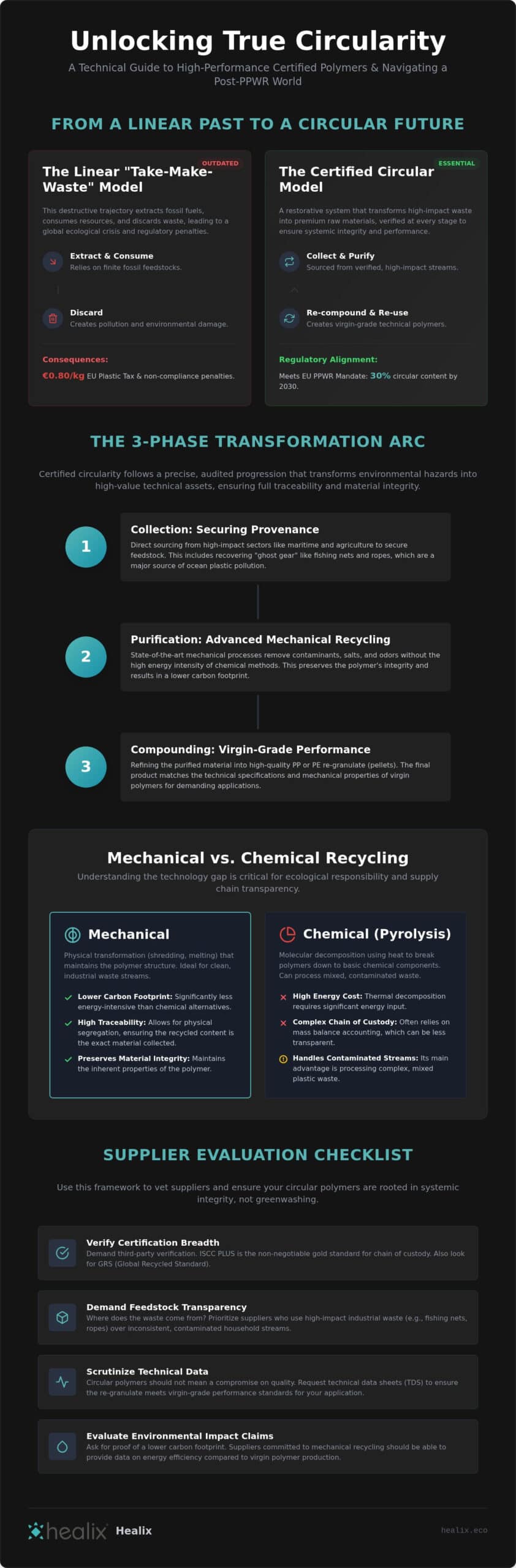
Traditional plastic production follows a destructive linear trajectory. We extract, we consume, and we discard. This “take-make-waste” model has led to a global ecological crisis that requires a fundamental re-engineering of our industrial logic. What Are Certified Circular Polymers and Why Do They Matter? In short, they are the building blocks of a restorative industrial system. Certified circular polymers are materials derived from pre-existing plastic waste rather than fossil feedstocks, with every stage of their journey verified by independent, third-party auditors. This isn’t just about recycling; it’s about systemic integrity. With the EU Packaging and Packaging Waste Regulation (PPWR) now in effect, global brands are racing to meet a 30% circular content threshold by 2030. Failure to adapt means facing a €0.80 per kilogram plastic tax and losing the trust of a principled consumer base.
It’s vital to distinguish between standard post-consumer resin (PCR) and industrial circular polymers. While PCR typically originates from household waste streams, which are often contaminated and inconsistent, industrial circular polymers focus on high-impact waste like fishing nets and ropes. This distinction matters for performance. Industrial streams provide a more predictable feedstock, allowing manufacturers to maintain virgin-grade performance while achieving measurable ESG targets. Choosing the right stream ensures that your transition to circularity doesn’t compromise the physical integrity of your product.
The Role of Third-Party Certification
Self-claims are a liability in a high-stakes regulatory environment. Without external verification, “recycled” is just a word. ISCC PLUS (International Sustainability and Carbon Certification) has emerged as the global gold standard for circularity. This framework ensures a transparent chain of custody from the moment waste is collected to the final delivery of high-quality PP or PE pellets. It provides the empirical proof needed to combat greenwashing and satisfy rigorous compliance audits. For a certified circular polymers supplier, this certification is the non-negotiable baseline of professional stewardship. Manufacturers seeking to evaluate and compare these standards in depth will find a thorough recycled ocean plastic certification comparison invaluable for navigating the landscape of competing frameworks.
From Waste to Resource: The Transformation Arc
True circularity follows a precise, three-phase arc that transforms environmental hazards into technical assets. This methodical progression ensures that waste is not just moved, but fundamentally restored to a high-value state.
- Collection: Direct sourcing from high-impact sectors like fishing and farming to secure feedstock provenance and clear the oceans of “ghost gear.”
- Purification: Advanced mechanical processes that remove contaminants and odors without the extreme energy intensity of pyrolysis.
- Compounding: Refining the material into high-quality re-granulate that matches the technical specifications of virgin polymers for automotive or packaging applications.
When a polymer is “certified,” it means every phase of this arc is documented, audited, and held to a standard of environmental stewardship. This transparency is what allows a brand to claim true circularity with confidence.
Mechanical vs. Chemical Recycling: Navigating the Technology Gap
The transition to a circular economy requires a clear-eyed assessment of the technologies driving it. We face a choice between mechanical and chemical processes, each offering distinct pathways for certified circular polymers. Mechanical recycling involves the physical transformation of waste through cleaning, shredding, and melting. In contrast, chemical recycling, or pyrolysis, uses thermal decomposition to break plastics down into their molecular components. While chemical methods can handle complex, mixed-stream waste, they often come at a significant energy cost.
Choosing the right technology is not just a matter of logistics; it’s a matter of ecological responsibility. Mass Balance vs. Physical Segregation: Which Offers More Transparency? This question is central to how we verify the origin of our materials. Mechanical recycling allows for a higher degree of physical traceability, ensuring that the high-impact waste we collect, such as industrial ropes, is the exact material returned to the supply chain. This direct link provides a level of transparency that accounting-based chemical models often struggle to match.
The Energy Efficiency of Mechanical Processes
Mechanical recycling sits at the top of the waste hierarchy for a reason. It avoids the massive energy expenditure required to crack polymer chains back into monomers. By preserving the physical structure of the plastic, we significantly reduce the associated CO2 emissions. This process maintains the material integrity of the polymer, ensuring that the resulting high quality recycled pellets perform with the same reliability as virgin resins. Mechanical recycling is the most direct path to circularity for high-quality fiber waste. It’s the logical choice for industrial applications where performance and carbon reduction are equally weighted.
When Chemical Recycling is Necessary
There are instances where mechanical processes reach their limit. Multi-layer films, highly contaminated post-consumer streams, and certain medical plastics cannot be effectively purified through physical means. In these cases, chemical recycling serves as a necessary catch-all. It ensures that even the most difficult waste streams are diverted from landfills, though it should be viewed as a secondary option to the more efficient mechanical route. By understanding these technological boundaries, brands can strategically source materials that maximize both performance and environmental restoration.
Mass Balance vs. Physical Segregation: Which Offers More Transparency?
The integrity of a circular supply chain depends entirely on how we account for the material moving through it. Buyers of certified circular polymers generally encounter two distinct methodologies: Mass Balance and Physical Segregation. While both are recognized under global standards, they offer fundamentally different levels of transparency. One relies on a credit-based ledger to track circularity, while the other maintains a physical, unbroken link to the original waste source. Choosing between them is a decision that impacts both your ESG reporting and your brand’s ethical narrative.
Modern buyers are increasingly skeptical of accounting-based sustainability. They demand a trust factor that only physical traceability can provide. Selling “recycled molecules” through a mass balance ledger is a pragmatic start for the industry, but selling “recycled products” with a clear provenance is the ultimate goal for visionary leaders. Physical segregation enables brands to tell a story of transformation that resonates with stakeholders. It moves the conversation from abstract carbon credits toward tangible environmental health, ensuring that your commitment to the planet is visible, measurable, and absolute.
Understanding the ISCC PLUS Mass Balance Model
Mass Balance is an accounting-based approach designed for large-scale petrochemical infrastructure. It allows circular feedstocks to be co-processed with virgin fossil materials in existing refineries where physical separation is technically impossible. Credits are assigned to the output based on the volume of recycled input. This model facilitates the rapid scaling of circularity within massive industrial systems. However, it’s vital to understand that the specific product you purchase might contain zero recycled molecules; it simply carries the “credit” of the circular input elsewhere in the system. While efficient for the industry, it creates a layer of abstraction that can complicate direct environmental claims.
The Power of Physical Traceability
Physical Segregation is the uncompromising alternative. In this model, the recycled content is physically tracked, processed, and kept entirely separate from virgin streams at every stage. When a brand claims a product is made from 100% recycled content, Physical Segregation provides the empirical proof required to back that claim. This approach eliminates the “dilution” of environmental impact inherent in mass balance models. It allows you to secure a technical resource born from specific, high-impact waste. For those Choosing a Circular HDPE Supplier, physical segregation represents the gold standard of supply chain integrity. It ensures that the circularity you pay for is the circularity you physically receive.
Buyer’s Checklist: 5 Criteria for Evaluating Circular Polymer Suppliers
Securing a resilient supply chain requires a rigorous vetting process that moves beyond surface-level claims. As you transition to certified circular polymers, your procurement strategy must prioritize empirical data and technical reliability. This is not merely a purchasing decision; it’s a commitment to systemic integrity and the transparency required for certified circular polymers to thrive in a global market. To ensure your raw materials meet the demands of high-performance applications, evaluate potential partners against these five essential criteria.
- Certification Breadth: Confirm the supplier holds ISCC PLUS or GRS (Global Recycled Standard) credentials. These frameworks provide the audited proof of circularity that regulators and stakeholders demand. A structured recycled ocean plastic certification comparison can help you assess which standard best aligns with your supply chain’s traceability and compliance requirements.
- Feedstock Provenance: Demand specificity. A transparent supplier can name the exact origin of their waste, such as discarded fishing nets or industrial ropes, rather than using vague “post-industrial” descriptors.
- Technical Performance: Verify that the recycled polypropylene granules align with your Melt Flow Index (MFI) requirements to ensure processing stability.
- Scalability and Consistency: Audit the supplier’s ability to provide industrial volumes. High-purity recycled plastic pellets must maintain stable batch-to-batch quality to avoid production downtime or material failure.
- Environmental LCA: Request a process-specific Life Cycle Assessment. You need to know the exact carbon footprint reduction achieved by their specific recycling methodology compared to virgin alternatives. Procurement teams navigating the 2026 regulatory deadline will benefit from reviewing the EU plastic tax compliance materials checklist to align sourcing decisions with PPWR declaration of conformity requirements.
Testing for Technical Parity
Success in circular manufacturing depends on “drop-in” solutions. You shouldn’t have to re-tool your injection molds or sacrifice cycle times to accommodate recycled content. Request physical samples to perform independent testing for tensile strength and impact resistance. High-performance polymers should match virgin specifications, allowing for a seamless transition that maintains product excellence. If a material requires significant machine adjustments, it may not possess the technical maturity your operations require.
Auditing the Supply Chain Source
Industrial waste streams often offer superior consistency compared to fragmented consumer waste. Materials sourced from the fishing and farming sectors provide a cleaner, more predictable feedstock for high-tech mechanical recycling. When reviewing supplier documentation, watch for red flags like missing batch numbers or inconsistent provenance records. A principled leader in this space welcomes scrutiny and provides the transparency needed to build lasting trust. Request technical specifications for our high-quality re-granulate to see how we define supply chain integrity.
Healix: Transforming High-Impact Waste into Premium Circular Polymers
The global plastic crisis demands more than incremental adjustments. It requires a fundamental transformation of how we perceive and process industrial waste. Healix exists to redefine the ethical boundaries of the plastic industry by proving that ecological restoration and industrial performance are not mutually exclusive. We don’t just participate in the market; we act as a visionary guide for a movement toward systemic integrity. By providing certified circular polymers derived from the most challenging marine and agricultural waste, we offer brands a tangible way to manifest their ESG commitments through physical action.
Our focus centers on “Ghost Gear,” the discarded fishing nets and ropes that threaten marine biodiversity and clog our oceans. These materials are high-impact environmental hazards, yet they possess the physical properties required for premium technical resources. Our Dutch-based facility employs precision engineering to transform these resilient fibers into high-purity recycled plastic pellets of PP and PE. This is the logical conclusion for any brand seeking systemic change: a supply chain that actively heals the planet while maintaining virgin-grade performance. It’s a shift from being a consumer of resources to becoming a restorer of ecosystems.
The Healix Process: Clean, Mechanical, Traceable
Our methodology follows a rigorous three-stage arc designed for maximum transparency and minimal environmental footprint. This methodical progression ensures that every ton of material we produce carries a verified story of transformation. We’ve optimized each phase to ensure the highest possible purity for industrial applications.
- Collection: We execute direct sourcing from marine and farming sectors, securing a feedstock with undeniable provenance and high environmental impact.
- Purification: We utilize advanced mechanical cleaning and purification technologies that bypass the high energy intensity and carbon footprint of chemical pyrolysis.
- Pelletizing: We produce high-quality re-granulate through a precision compounding process that ensures batch-to-batch consistency for automotive and packaging sectors.
Crucially, we utilize 100% recycled feedstock. We don’t rely on virgin blending to mask quality inconsistencies. Every pellet is a testament to the power of mechanical recycling and the physical integrity of certified circular polymers. This approach ensures that your recycled content claims are backed by empirical, traceable data.
Collaborative Action for a Circular Future
The transition to a circular economy is a collective responsibility that requires bold leadership. It requires visionary manufacturers who are willing to look beyond the status quo of the linear “take-make-waste” model. By choosing materials with high-impact origins, you aren’t just buying a raw material; you’re investing in the restoration of our oceans. We invite you to join this mission and redefine what’s possible in your industry. Empower your supply chain with Certified Circular Plastic from Healix and turn your sustainability targets into a measurable reality.
Securing the Future of Circular Manufacturing
The global mandate for circularity is no longer a distant ambition; it’s a present industrial reality. We’ve explored how navigating the technical gap between recycling methodologies and understanding the nuances of physical traceability are essential steps for any procurement leader. By prioritizing certified circular polymers that offer high-performance parity with virgin materials, you protect your brand from greenwashing risks while meeting stringent ESG targets. Choosing the right material source is the first step in a larger movement toward systemic integrity.
True systemic change requires more than just participation. It demands a commitment to restoration. Through Dutch innovation in mechanical recycling, we transform discarded marine gear into technical resources that don’t compromise on quality. You have the power to redefine your supply chain’s ethical boundaries by choosing materials that are ISCC PLUS certified and physically traceable. This approach ensures your commitment to the planet is visible and absolute.
It’s time to move beyond industrial failure and toward a restorative future. Request a Technical Datasheet for Healix Circular Polymers to see how our high-performance PP and PE pellets can empower your next manufacturing cycle. We look forward to building a cleaner, more resilient world together.
Frequently Asked Questions
What is the difference between circular and recycled polymers?
Circular polymers represent a systemic evolution beyond standard recycled materials by focusing on closed-loop integrity and third-party verification. While “recycled” often describes any material diverted from waste, certified circular polymers are audited to ensure they return to the supply chain with documented provenance. This distinction emphasizes the transformation of waste into a technical resource that maintains high performance while supporting a restorative economy. It’s about systemic health rather than just waste diversion.
Is ISCC PLUS certification mandatory for circular plastics?
ISCC PLUS certification isn’t legally mandatory globally, but it’s becoming the de facto standard for regulatory compliance and brand protection. As the EU Packaging and Packaging Waste Regulation (PPWR) imposes strict circularity requirements, this third-party verification provides the empirical proof needed to avoid plastic taxes and greenwashing allegations. It establishes a transparent chain of custody that stakeholders and auditors now expect as a baseline for professional stewardship in the plastics industry.
Can certified circular polymers be used in food contact applications?
Mechanical recycling of PP and PE currently faces regulatory hurdles for direct food contact in many jurisdictions, including the EU. While chemical recycling can achieve food-grade purity through molecular breakdown, mechanical processes are often restricted to non-food applications like secondary packaging or industrial parts. However, high-purity mechanical re-granulate is ideal for automotive, construction, and durable consumer goods where performance and carbon reduction are the primary objectives for a circular supply chain.
How does the carbon footprint of mechanical recycling compare to virgin plastic?
Mechanical recycling significantly reduces carbon emissions compared to virgin plastic production by bypassing the energy-intensive extraction and refining of fossil feedstocks. By physically transforming existing waste into high-quality pellets, the process preserves the energy already invested in the polymer chains. While exact reductions depend on the specific life cycle assessment, mechanical processes generally outperform both virgin production and chemical recycling in terms of energy efficiency and greenhouse gas mitigation.
What are the most common applications for recycled PP and PE pellets?
Recycled PP and PE pellets serve as high-performance technical resources across diverse industrial sectors. Common applications include automotive components, heavy-duty crates, industrial packaging, and agricultural equipment. These certified circular polymers are engineered to match the Melt Flow Index and tensile strength of virgin resins, making them suitable for injection molding and extrusion processes. They allow brands to maintain product excellence while clearing high-impact waste like fishing nets from the environment. For businesses in the health and food sectors looking for expert downstream partners, visit Simplepack Ltd.
Using high-quality circular polymers typically doesn’t require re-tooling or replacing existing manufacturing machinery. Our re-granulate is designed as a “drop-in” solution that integrates seamlessly into standard injection molding and extrusion lines. By matching the technical specifications of virgin materials, these pellets ensure stable cycle times and consistent output. Manufacturers can transition to a circular model without the capital expenditure associated with new equipment or significant process adjustments, making it easier for brands to source sustainable promotional materials from specialists like Ferelli Creations.
What is the ‘mass balance’ approach in the context of ISCC PLUS?
The mass balance approach is an accounting-based method that tracks circular feedstocks through complex manufacturing systems where physical separation isn’t possible. It allows companies to mix recycled and virgin materials in existing infrastructure while allocating circular “credits” to specific final products. This model facilitates the rapid scaling of the circular economy within large-scale petrochemical plants. It provides a verifiable way to support recycled content claims even when physical segregation is technically unfeasible.
How can I verify the origin of the plastic waste used in my polymers?
You can verify the origin of plastic waste through detailed chain-of-custody documentation and third-party audit reports provided by your supplier. Principled leaders in the circular economy offer transparency regarding feedstock provenance, such as sourcing directly from the fishing or farming sectors. By reviewing ISCC PLUS or GRS certificates, you can trace the material back to its collection point. This empirical evidence is vital for backing environmental claims and ensuring your supply chain’s ethical integrity.