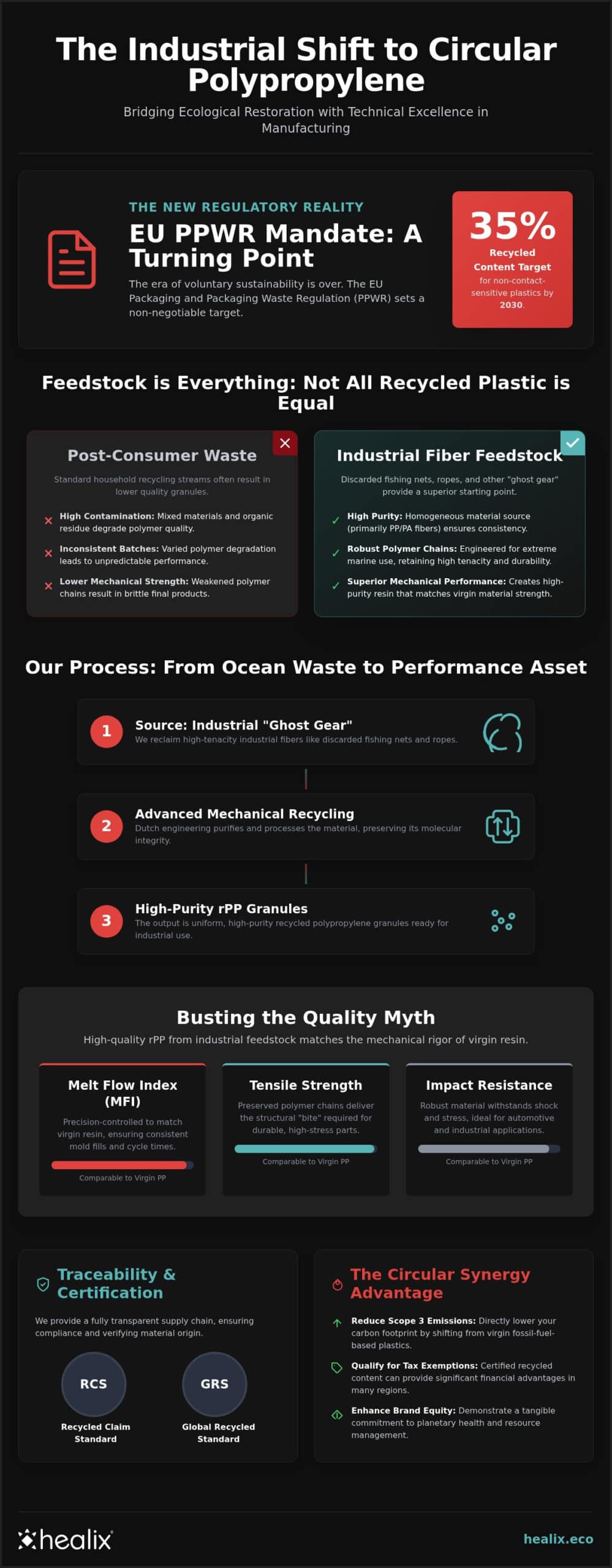
The era of voluntary sustainability has ended, replaced by a global mandate for circularity that demands immediate industrial evolution. With the EU Packaging and Packaging Waste Regulation (PPWR) setting a 35% recycled content target for non-contact-sensitive plastics by 2030, the pressure to transition is no longer theoretical; it’s a matter of regulatory survival. You likely recognize this urgency, yet you’ve hesitated because of the persistent myth that circular materials can’t match the mechanical rigor of virgin resin. It’s exhausting to deal with inconsistent batches or a lack of transparency when your production quality is at stake.
This article shows you how to bridge the gap between ecological restoration and technical excellence. You’ll learn how to integrate certified recycled polypropylene granules into your existing supply chains without compromising on traceability or material strength. We’ll examine how transforming “ghost gear” into high-purity feedstock allows you to meet strict ISO 15343 standards while maintaining your current manufacturing speed. Discover how Dutch engineering is turning industrial waste into a high-performance asset that protects the planet and your bottom line.
Key Takeaways
- Learn how to evaluate Melt Flow Index (MFI) and tensile strength to ensure recycled polymers meet the rigorous mechanical demands of industrial injection molding.
- Discover the precise machinery adjustments and temperature profile tuning required to successfully integrate recycled polypropylene granules into your existing production lines.
- Understand the critical role of RCS and GRS certifications in verifying material origin and ensuring your supply chain remains compliant with evolving global environmental mandates.
- Explore how advanced mechanical recycling of high-tenacity fiber waste, such as fishing nets, produces a high-purity resin that maintains structural integrity.
- Identify strategies for blending recycled and virgin resins to achieve a “Circular Synergy” that optimizes material performance while significantly reducing your carbon footprint.
Understanding Recycled Polypropylene Granules in the Circular Economy
Industrial manufacturing is undergoing a radical purification. Recycled polypropylene (rPP) granules are no longer mere secondary materials; they’ve become the primary building blocks of a resilient, circular economy. These granules represent processed raw material, meticulously sorted and pelletized to re-enter production cycles. While chemical recycling breaks polymers down to their molecular origins, advanced mechanical recycling focuses on maintaining the structural backbone of the material. This distinction is vital for understanding Polypropylene properties and recycling, as mechanical processes often offer a lower carbon footprint and faster integration for high-demand applications.
The regulatory environment has shifted from encouraging “recyclable” designs to mandating actual “recycled content” integration. With the EU Packaging and Packaging Waste Regulation (PPWR) applying from August 12, 2026, manufacturers face immediate legal requirements to secure a reliable supply of recycled polypropylene granules. This transition isn’t just about compliance; it’s a strategic move to decouple industrial growth from virgin fossil fuel extraction and mitigate the global plastic crisis.
This commitment to resource recovery mirrors advancements in other heavy industries, such as the oil and gas sector, where companies like TEG Reclamation Services provide essential glycol reclamation and dehydration services to ensure process efficiency and reduce environmental impact.
The Role of rPP in Modern Sustainability Goals
Transitioning to circular raw materials is the most direct path to reducing Scope 3 emissions. By integrating rPP, companies transform their supply chain from a linear drain into a restorative loop. Beyond ecological impact, this shift provides tangible economic protection. Many regions now offer plastic tax exemptions for products containing high percentages of certified recycled content, turning sustainability into a competitive financial advantage. It’s a powerful way to build brand equity by proving a commitment to planetary health through measurable resource management.
Post-Consumer vs. Industrial Fiber Feedstock
The quality of the final granule depends entirely on the history of the waste. Standard household recycling streams are often plagued by multi-material contamination and degraded polymers. In contrast, industrial fiber waste, specifically discarded fishing nets and ropes, offers a superior starting point. Because these fibers were originally engineered for extreme marine environments, they possess robust polymer chains. Transforming this high-tenacity waste into recycled polypropylene granules ensures a level of purity and mechanical performance that post-consumer waste simply cannot match. Dutch engineering at the forefront of this transformation allows manufacturers to maintain high-speed production without the risk of material failure, effectively bridging the gap between ecological goals and industrial realities.
Technical Specifications: Matching rPP to Industrial Requirements
Precision defines the success of industrial manufacturing. For injection molders, the Melt Flow Index (MFI) dictates everything from cycle times to part integrity. If your recycled polypropylene granules don’t meet specific flow requirements, your production line stalls. Manufacturers must analyze MFI with the same rigor applied to virgin resin to avoid flashing or incomplete mold fills. The margin for error is zero when you’re managing high-volume output.
Many engineers worry that recycled resin lacks the structural “bite” of virgin material. However, high-quality regranulate matches the technical properties of recycled polypropylene in key areas like tensile strength and impact resistance. Thermal stability is equally critical. During high-speed manufacturing, the polymer must withstand multiple heat cycles without degrading. Advanced compounding now allows for color consistency that satisfies aesthetic requirements while maintaining the structural performance needed for automotive or industrial applications.
The Science of Mechanical Recycling at Healix
We don’t just process waste; we restore polymer integrity. Our Dutch-based facility utilizes advanced mechanical purification to preserve the molecular weight of PP. By focusing on high-tenacity industrial fibers like discarded fishing nets and ropes, we start with a material that was built for extreme stress. This process transforms tangled “ghost gear” into uniform, high-purity recycled polypropylene granules. This rigorous approach ensures batch-to-batch consistency, allowing you to run large-scale industrial cycles with total confidence in your material supply.
Key Performance Indicators for Procurement
Procurement teams must look beyond the price tag to evaluate the technical DNA of their feedstock. High-quality regranulate should maintain an ash content below 1.5% and moisture levels under 0.1% to ensure optimal processing. Density and filtration levels are also vital. Fine melt filtration removes microscopic contaminants that could otherwise cause structural weak points in finished parts. You can view our full technical data sheets to see how our certified circular plastic aligns with your specific machinery requirements. Matching granule size to your existing gravity-fed or vacuum systems prevents feeding interruptions, ensuring that the transition to circularity is as seamless as it is sustainable.
Overcoming the Quality Myth: Recycled vs. Virgin Polypropylene
The assumption that recycled polymers are inherently inferior to virgin resin is a legacy of the past. For decades, the industry viewed recycled plastic as a material destined for “downcycling” into low-value items like park benches or floral pots. Today, advanced mechanical recycling has shattered this narrative. High-purity recycled polypropylene granules now deliver structural properties that allow for seamless integration into high-value industrial applications. We’re no longer talking about a compromise; we’re talking about a technical evolution that matches the rigor of virgin resin while solving the global waste crisis.
Many manufacturers achieve optimal results through “Circular Synergy,” a process of blending rPP with virgin resin to hit specific performance targets. This approach allows companies to meet mandatory recycled content quotas without altering their existing tooling or cycle times. We’ve seen this succeed in demanding sectors where failure isn’t an option. For example, automotive manufacturers are now utilizing 100% recycled industrial fibers for interior components, and premium luggage brands are crafting suitcases from high-tenacity “Ghost Gear” feedstock. These products endure extreme stress tests, proving that circular materials can survive the most punishing environments.
The economic argument for rPP has also reached a tipping point. While virgin prices fluctuate with oil markets, the cost-benefit analysis of recycled material now accounts for the rising “green premium.” With the EU Packaging and Packaging Waste Regulation (PPWR) introducing strict mandates for 2030, the financial risk of relying solely on virgin plastics is growing. Factoring in carbon pricing and potential plastic taxes makes the switch to certified circular pellets a pragmatic business decision that protects long-term profitability. Manufacturers expanding their circular polymer strategy beyond polypropylene should also evaluate how to select a reliable circular HDPE supplier to ensure consistent performance across their full range of industrial-grade recycled polymers.
Durability and Longevity in Finished Products
Fiber-derived rPP offers unique advantages in UV resistance and aging characteristics. Because the original industrial ropes and nets were engineered to withstand years of saltwater and sun exposure, the resulting granules retain a robust molecular structure. We utilize rigorous testing protocols to verify that every batch maintains the impact resistance required for industrial-grade performance. It’s a purification process that respects the material’s history while preparing it for a new, high-performance life cycle.
Environmental Impact: Virgin vs. Recycled
The ecological math is undeniable. Life Cycle Assessments (LCA) consistently show that mechanical recycling requires significantly less energy and water than virgin production. By transforming discarded fishing nets into recycled polypropylene granules, we prevent “Ghost Gear” from destroying marine ecosystems. This isn’t just about reducing a carbon footprint; it’s about active restoration. Every ton of regranulate produced represents a direct intervention in the health of our oceans, turning a global environmental threat into a valuable industrial asset.
Traceability and Certification: Ensuring a Clean Supply Chain
Industrial transparency is no longer a luxury; it’s a foundational requirement for the modern circular economy. While consumer-facing symbols like the “chasing arrows” once sufficed for marketing, they offer zero technical value for industrial procurement. To avoid the legal and reputational risks of greenwashing, manufacturers must demand rigorous, third-party verification. In 2026, certifications such as the Recycled Claim Standard (RCS) and the Global Recycled Standard (GRS) have become the definitive benchmarks for material integrity. These frameworks ensure that every kilogram of recycled polypropylene granules entering your facility has a documented history that survives the most intense regulatory scrutiny. For a comprehensive breakdown of how to evaluate and procure certified circular polymers with verified quality and traceability, a structured procurement framework is essential to navigating these complex standards.
The future of polymer management lies in the integration of blockchain technology and digital product passports (DPP). These tools create a tamper-proof record of the material’s journey, providing a level of granular data that was previously impossible to track. From the moment industrial fiber waste is recovered to its final transformation into high-purity pellets, every stage is recorded. This digital thread allows brands to prove the origin of their materials, satisfying both internal ESG targets and the growing demands of conscious consumers who expect radical honesty from the products they purchase.
Why Certified Circular Plastic Matters
Legal defensibility is the primary driver for certified materials. As global authorities crack down on unsubstantiated environmental claims, brands need a bulletproof audit trail to protect their market position. We maintain a closed-loop documented supply chain that tracks “Ghost Gear” from ocean recovery through our Dutch engineering facility to the final regranulate. This level of oversight ensures that your claim of using certified circular plastic is backed by hard evidence, not just hopeful intentions. It’s about building a partnership based on technical truth and shared ecological responsibility.
Navigating Global Polymer Regulations
The regulatory landscape is tightening with unprecedented speed. The EU’s Packaging and Packaging Waste Regulation (PPWR), which applies from August 12, 2026, mandates strict compliance across all member states. Beyond Europe, the UN Global Plastics Treaty is set to redefine industrial procurement on a global scale. Adopting ISO 15343 standards for tracing and verifying recycled content is now a strategic necessity for future-proofing your supply chain. By securing a reliable flow of recycled polypropylene granules that meet these international standards today, you insulate your business against the legislative shifts of tomorrow. Request our full certification documentation to see how we align with your compliance requirements.
Implementing Recycled PP Granules in Your Production Line
Moving from virgin resin to circular materials is a tactical shift that requires more than just a change in procurement. It’s a technical recalibration. Manufacturers must approach the integration of recycled polypropylene granules with a methodical testing phase to ensure that machinery settings align with the unique thermal behavior of recycled polymers. While the environmental mandate is urgent, the execution must be precise to maintain the industrial speed your facility demands.
Unlike virgin pellets, recycled batches often require slight adjustments to temperature profiles and cycle times. To assist with these technical calibrations, you can find out more about material-specific behavior. Because the molecular history of the polymer includes previous heat cycles, cooling rates and melt behavior may vary. Fine-tuning the back pressure and injection speed prevents structural voids; this ensures that the final product maintains the same impact resistance and tensile strength discussed in our previous technical analysis. This isn’t about compromising on quality; it’s about mastering a more sophisticated raw material.
Stop thinking of recycling as a spot-market transaction. To secure a resilient supply chain, global manufacturers are moving toward long-term circular partnerships. This shift ensures volume stability and consistent material quality, protecting your production line from the price volatility and supply shortages that often plague uncertified markets. By locking in a reliable stream of high-quality re-granulate, you insulate your operations against the regulatory shifts of 2026 and beyond.
The story of the material is your brand’s newest asset. Marketing the transformation of discarded industrial fiber waste into high-performance products resonates with consumers who demand tangible action. It moves the conversation from vague “eco-friendly” claims to a specific narrative of ocean restoration and resource purification. When you tell the story of “Ghost Gear” becoming a durable consumer product, you turn a technical manufacturing choice into a powerful message of environmental stewardship.
Pilot Testing and Material Validation
Conducting small-scale trials is the only way to verify Melt Flow Index (MFI) and shrinkage rates within your specific molds. We recommend starting with a pilot blend and gradually increasing the ratio as you monitor the part’s dimensional stability. Collaborating directly with your recycling partner allows you to “tune” the granule properties, potentially adjusting the compounding stage to meet your exact mechanical requirements. This collaborative approach reduces the risk of downtime and ensures a seamless transition to circular feedstock.
Partnering with Healix for Circular Success
We provide the technical expertise necessary to bridge the gap between waste recovery and high-end manufacturing. Our Dutch engineering facility specializes in transforming complex industrial fiber waste into customized recycled polypropylene granules for the automotive, construction, and consumer goods sectors. We don’t just supply pellets; we act as a collaborative partner in your transition to a restorative business model. By choosing our certified circular plastic, you’re investing in a future where industrial growth and ecological health are no longer in conflict. Join the circular mission and request a sample of our certified PP pellets.
Leading the Industrial Transition to Circularity
The shift toward circular manufacturing is no longer a distant vision; it’s a present-day industrial imperative. We’ve explored how advanced mechanical recycling preserves polymer integrity, allowing recycled polypropylene granules to meet the rigorous demands of the automotive and industrial sectors. By securing RCS-certified materials, your brand moves beyond the risk of greenwashing and into a future of verifiable, documented sustainability. Dutch technical leadership has proven that transforming “ghost gear” into high-purity resin isn’t just possible, it’s a strategic advantage for global leaders.
Integrating these materials requires precision and a commitment to long-term partnerships rather than spot-buying. As regulations like the PPWR take effect, the ability to maintain manufacturing speed while reducing your carbon footprint becomes a critical differentiator. It’s time to bridge the gap between high-level ecological goals and the practical realities of your production line. Transform your supply chain with certified circular PP from Healix and join a mission that restores the planet while strengthening your business. Together, we can turn the tide on industrial waste and build a truly restorative economy.
Frequently Asked Questions
What is the difference between recycled polypropylene granules and re-granulate?
These terms are often used interchangeably in manufacturing, but they describe different aspects of the material. Granules refer to the specific pelletized form of the plastic, which is optimized for gravity-fed and vacuum systems in industrial machinery. Re-granulate is the broader technical term for any polymer that has been processed back into a granular state after its initial use. Both serve as the primary circular feedstock for modern production lines.
Can recycled PP granules be used for food-contact packaging?
Most mechanically recycled polypropylene, including resin derived from industrial fibers, is currently restricted from direct food-contact applications in many regions. While chemical recycling can achieve food-grade purity, mechanical recycling is the superior choice for demanding industrial, automotive, and non-food packaging sectors. These applications prioritize structural integrity and carbon footprint reduction over the extreme sterilization requirements of food-contact materials.
How does the Melt Flow Index (MFI) of recycled PP compare to virgin resin?
High-quality recycled polypropylene granules are engineered to match specific virgin MFI ranges, typically between 10 and 40 g/10 min depending on the application. While recycled polymers can show slight variations between batches, advanced Dutch mechanical purification ensures the MFI remains consistent enough for high-speed industrial production. This consistency allows manufacturers to maintain their existing cycle times without requiring significant machinery modifications or downtime.
What certifications should I look for when buying recycled plastic pellets?
Manufacturers must prioritize third-party certifications like the Recycled Claim Standard (RCS) or the Global Recycled Standard (GRS) to ensure absolute chain-of-custody transparency. These standards verify the material is truly recycled and track it from the point of recovery to the final pellet. Additionally, ISO 15343 is critical for verifying the traceability of recycled content, helping brands avoid the legal and reputational risks associated with greenwashing. Procurement teams seeking deeper technical guidance on evaluating these standards should consult a dedicated resource on sourcing certified circular polymers that meet rigorous quality and traceability benchmarks.
How does using granules from fishing nets help the environment?
Transforming “ghost gear” into raw material removes one of the most lethal forms of marine plastic pollution from our oceans. By choosing pellets derived from industrial ropes and nets, manufacturers prevent these high-tenacity fibers from entangling marine life or breaking down into microplastics. This process actively restores marine ecosystems while simultaneously reducing the industrial demand for virgin fossil-fuel-based resins, creating a restorative loop for the planet.
Can I use 100% recycled PP granules in my injection molding machine?
Many industrial applications successfully utilize 100% recycled polypropylene granules, particularly when the feedstock comes from high-tenacity industrial fibers. These fibers maintain the molecular weight necessary to perform as a standalone resin in demanding structural parts. Some manufacturers choose a “Circular Synergy” blend with virgin resin for ultra-specific performance targets, but the purity of modern re-granulate makes 100% integration a practical reality for many sectors.
What is the typical lead time for industrial-scale rPP procurement?
Lead times generally range from four to eight weeks for established circular supply chains, depending on volume and specific technical requirements. Moving from spot-buying to long-term partnerships is the most effective way to secure a consistent flow of material. This collaborative approach ensures that your production schedule isn’t disrupted by the inherent volatility of the global recycling market, providing the volume stability needed for large-scale industrial runs.
How do recycled PP granules impact the color of the final product?
Recycled pellets typically result in darker or more opaque shades, such as deep greens, greys, or blacks, because of the mixed history of the source material. While achieving perfectly transparent or bright white finishes is difficult with mechanical recycling, compounding with masterbatches allows for a wide range of consistent industrial colors. These customized shades satisfy most automotive and industrial aesthetic requirements while clearly signaling the product’s circular origins to the end consumer.