The global transition to a circular economy isn’t a distant aspiration; it’s a regulated industrial mandate with the EU Packaging and Packaging Waste Regulation setting strict recycled content targets for 2030. For many manufacturers, the shift to high-purity recycled plastic pellets often feels like a compromise between sustainability and performance. You’ve likely struggled with batch-to-batch inconsistency, unexpected machine downtime from contamination, or the complex burden of proving traceability for ESG audits. These aren’t just inconveniences; they’re systemic failures that threaten your supply chain integrity. We understand the gravity of these challenges and the urgency required to solve them.
We believe that industrial-grade feedstock should perform with the same precision as virgin resin. This article provides the technical framework you need to specify polymers that meet rigorous density and Melt Flow Index standards. You’ll discover how to transform high-stakes industrial waste into a reliable raw material that supports large-scale production. We’ll examine the three critical phases of the specification process: auditing feedstock origins, verifying mechanical purification standards, and securing certified circularity documentation. By the end of this guide, you’ll have the expertise to lead your organization toward a future where waste is no longer a liability, but a high-performance asset.
Key Takeaways
- Define purity beyond surface-level cleanliness by targeting the elimination of volatile organic compounds and non-polymer contaminants.
- Master the technical benchmarks—specifically MFI, density, and tensile strength—needed to specify high-purity recycled plastic pellets for high-performance molding.
- Identify why industrial-gear fiber waste, such as fishing nets and ropes, offers a more robust molecular structure than standard post-consumer plastics.
- Evaluate how advanced mechanical recycling processes preserve material integrity while providing the transparency required for rigorous ESG reporting.
- Discover the methodology for integrating certified circular polymers into existing production lines without the need for significant capital expenditure.
Defining Purity in the Circular Polymer Economy
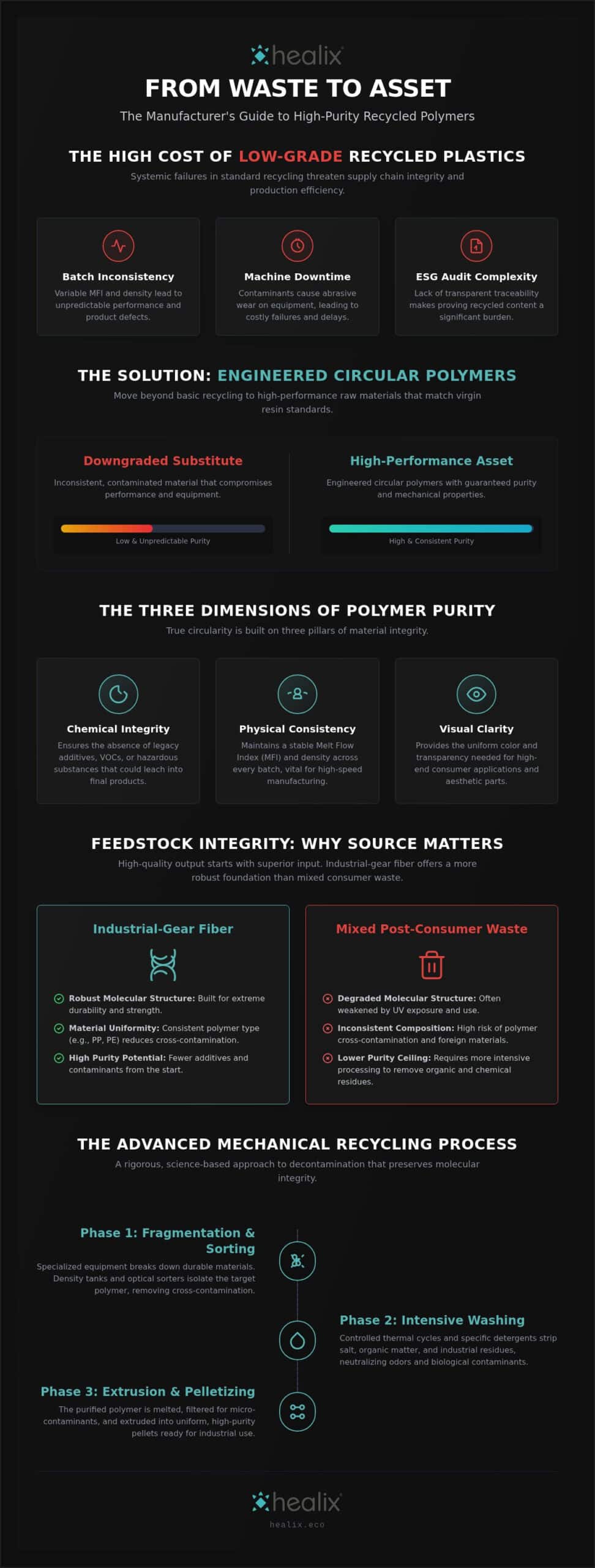
Industrial sustainability depends on an uncompromising metric: purity. While the process of recovering scrap or waste plastic has existed for decades, the gap between basic recycling and true circularity remains wide. Purity in the circular economy isn’t just about washing. It requires the absolute removal of volatile organic compounds (VOCs) and non-polymer contaminants that compromise material integrity. We must move beyond simple waste management toward the realm of precision engineering.
Purity is the primary bottleneck preventing the mass adoption of circular plastics. Manufacturers shouldn’t have to choose between their ESG targets and their production efficiency. When you specify high-purity recycled plastic pellets, you aren’t buying clean scrap. You’re investing in engineered circular polymers. These materials match the mechanical properties of virgin resin, ensuring that your production lines remain stable and your final products remain durable. It’s the difference between a downgraded substitute and a high-performance raw material.
The Three Dimensions of Polymer Purity
True polymer integrity is built on three pillars. First, chemical integrity ensures the absence of legacy additives or hazardous substances that could leach into final products. Second, physical consistency maintains a stable Melt Flow Index (MFI) and density across every batch. This predictability is vital for high-speed manufacturing environments where consistency is king. Finally, visual clarity provides the uniform color and transparency needed for high-end consumer applications. If any of these dimensions fail, the polymer isn’t truly circular; it’s just downgraded material.
Why Industrial Standards Demand High-Purity Pellets
Precision equipment requires precision feedstock. Even microscopic contaminants in low-grade regrind can cause abrasive wear on injection molding screws, leading to machine failure and expensive downtime. Using high-purity recycled plastic pellets protects your capital investment while meeting strict regulatory requirements for consumer safety. In sectors like automotive or infrastructure, structural integrity is a matter of public safety. High-purity resins ensure that critical components, from fuel systems to pressure pipes, perform reliably over their entire lifecycle. We don’t just recycle; we restore the material’s original potential.
The Technical Pillars of Industrial Plastic Purification
Achieving true circularity requires more than basic sorting. It demands a rigorous, science-based approach to decontamination. While chemical recycling technologies are gaining traction, advanced mechanical recycling remains the current efficiency leader for processing polyolefins. It offers a lower carbon footprint and preserves the molecular integrity of the polymer. By focusing on mechanical excellence, we can produce high-purity recycled plastic pellets that rival virgin resins in performance and consistency.
The transition from industrial waste to high-performance raw material follows a methodical tripartite logic. Each stage is designed to eliminate specific failure points that typically plague lower-quality recycled materials.
Phase 1: Advanced Fragmentation and Sorting
Transformation begins with the mechanical breakdown of high-tenacity materials like fishing nets and ropes. These industrial fibers are engineered for extreme durability, making them difficult to process without specialized equipment. We fragment these materials into uniform fractions to prepare them for separation. Density tanks then isolate PP and PE from heavier contaminants, while optical sorting technology identifies and removes polymer cross-contamination; for facilities requiring advanced material recovery, Sacor Engineering provides customized industrial separation solutions. This precision ensures that only the intended polymer stream reaches the next phase.
Marine and agricultural waste often carry heavy loads of salt, organic matter, and industrial residues. We employ specific detergents and controlled thermal cycles to strip these contaminants from the plastic surface. This intensive process neutralizes odors and ensures the material is biologically inert. Maintaining this level of cleanliness is essential for manufacturers aiming to meet standards for suitable purity for food-contact applications or sensitive consumer goods packaging. You can see how this methodology supports global sustainability goals through our work at Healix.
Phase 3: Precision Extrusion and Degassing
The final pillar of purification occurs during the melt phase. We utilize vacuum degassing to extract any remaining volatile organic compounds that survived the washing process. This step is critical for ensuring the final high-purity recycled plastic pellets are free from internal defects. Finally, the melt passes through fine-mesh screens to remove microscopic particles, resulting in a standardized pellet with a consistent Melt Flow Index. To ensure these filtration components remain effective, visit Compass Wire Cloth Corporation for insights on maximizing screen life. This three-stage rigor turns discarded ghost gear into a high-value industrial asset.
Feedstock Integrity: Why Ghost Gear Outperforms Mixed Post-Consumer Waste
The success of circular manufacturing depends entirely on the integrity of the input material. While kerbside collection systems capture high volumes of plastic, they often deliver a degraded “cocktail” of varied polymers. This mixed post-consumer waste frequently leads to downcycling, where the resulting material is unsuitable for high-performance applications. To produce high-purity recycled plastic pellets, we must look beyond the household bin and toward single-source industrial streams. Feedstock origin is the ultimate determinant of batch-to-batch consistency and molecular health.
Industrial fibers, specifically discarded fishing nets and ropes known as ghost gear, represent a superior class of feedstock. These materials were originally engineered for extreme environments. They possess a robust molecular structure designed to withstand UV radiation, saltwater corrosion, and immense mechanical tension. When we recover these fibers, we’re working with a polymer that hasn’t been compromised by the thin-wall, low-tenacity requirements of single-use packaging. Adhering to FDA guidance on purity for recycled plastics ensures that these high-integrity sources meet the most demanding industrial standards.
Industrial Fiber vs. Kerbside Mixed Plastics
The technical advantage of industrial fiber lies in its inherent mechanical properties. Ropes and nets offer significantly higher tensile strength and impact resistance compared to mixed consumer plastics. Because these streams are typically limited to PE and PP, the risk of cross-contamination from PET or PVC is drastically reduced. This chemical homogeneity is vital for maintaining stable production parameters. Industrial feedstock ensures predictable shrinkage rates in molding, allowing for tighter tolerances in precision manufacturing. By utilizing high-purity recycled plastic pellets derived from industrial fibers, manufacturers can achieve the same structural reliability they expect from virgin resins.
The Environmental Imperative of Marine Waste Recovery
Choosing ghost gear as a feedstock addresses a global ecological crisis. Abandoned fishing gear is the most lethal form of marine plastic pollution, haunting our oceans for decades and destroying fragile ecosystems. Recovering this waste isn’t just a sourcing strategy; it’s an act of restoration. We transform a destructive environmental liability into a high-performance industrial asset. This process links technical excellence with a mission of systemic change. It allows professional leaders to meet their sustainability mandates while directly contributing to the health of our planet’s most critical biomes. True circularity happens when industrial innovation serves ecological integrity.
Specifying High-Purity Pellets for Industrial Applications
Transitioning to circular polymers requires a rigorous technical framework. It isn’t enough to simply order recycled material; you must demand data sheets that mirror virgin resin standards. To ensure your production remains stable, focus on four critical pillars: Melt Flow Index (MFI) for processability, Density for structural weight, Tensile Strength for durability, and Ash Content to verify the success of the purification process. These metrics define the quality of high-purity recycled plastic pellets and determine their success on the factory floor. We believe that technical transparency is the only path to systemic change.
Integrating these pellets into existing production lines doesn’t require capital-intensive equipment overhauls. High-quality re-granulate is designed to be a drop-in solution or a high-percentage blend component. We recommend a purposeful, three-phase transition: trial, validate, and scale. Start with small-batch trials to monitor shrinkage and cycle times. Validate the mechanical performance against your specific product requirements. Finally, scale the circular content once you’ve established a stable baseline. This methodical approach minimizes risk while maximizing environmental impact.
Application Mapping: From Automotive to Sunglasses
Different sectors demand distinct performance profiles. In automotive manufacturing, recycled PP must deliver high impact resistance and thermal stability for under-the-hood components. Reusable logistics, such as industrial pallets or crates, require polymers with high load-bearing capacity and long-term creep resistance. Precision consumer goods, like high-end sunglasses or electronics, demand a flawless aesthetic finish and consistent coloration across batches. You can use our guide on certified circular polymers to help match these specific industrial needs with the correct material grade.
Ensuring Traceability and Compliance
As the EU Packaging and Packaging Waste Regulation (PPWR) targets approach, batch documentation has moved from a “nice-to-have” to a legal necessity. You must be able to prove the origin and recycled content of your feedstock for ESG reporting and regulatory audits. Professional suppliers provide comprehensive Life Cycle Assessment (LCA) data, allowing you to quantify the carbon savings of your material switch. Vetting your partners is critical to maintaining this chain of custody. Consult our framework for choosing a circular HDPE supplier to ensure your feedstock meets these emerging global standards.
The time for pilot projects has passed; the era of industrial-scale circularity is here. Explore our range of high-performance circular polymers to secure your supply chain today.
Healix: Transforming Marine Waste into Certified High-Quality Polymers
At Healix, we believe the plastic crisis requires more than incremental change. We’ve dedicated ourselves to redefining the ethical boundaries of the polymer industry by transforming environmental liabilities into high-performance industrial assets. By reclaiming discarded fishing nets and ropes, we prevent marine destruction while providing the raw materials necessary for a truly circular economy. This mission isn’t just about business; it’s about systemic restoration. We act as a visionary guide for manufacturers who refuse to settle for degraded materials.
Our proprietary methodology bridges the gap between ecological recovery and technical precision. We take high-stakes marine waste and subject it to a rigorous mechanical purification process. The result is a stream of high-purity recycled plastic pellets that meet the exacting standards of global manufacturers. We don’t just clean plastic. We engineer it for a second life in critical applications, ensuring that circularity never comes at the cost of performance.
Dutch Innovation, Global Impact
Our high-tech facility in the Netherlands serves as the epicenter of our operations. Here, Dutch engineering meets environmental stewardship to solve a global problem. We’ve optimized our processes to ensure we can supply consistent, large-scale volumes to global industrial supply chains. Manufacturers trust our facility because we provide more than just pellets; we provide scientific rigor. Every batch of high-purity recycled plastic pellets is backed by precise data and a philosophical commitment to future generations. We prove that industrial scale and ecological integrity can coexist.
Partnering for a Circular Future
We support manufacturers as they navigate the complex transition to circularity. Our collaborative approach focuses on three actionable phases: technical alignment, customized material specification, and transparent supply chain integration. We provide specialized solutions for specific industrial polymer requirements, ensuring our PE and PP resins integrate seamlessly into your production lines. You can learn more about our specific offerings in our guide on recycled polypropylene for circular manufacturing.
The global movement toward circularity requires bold innovators and authoritative experts. We invite you to join us in building a transparent, restorative supply chain that protects our oceans and empowers your industry. Contact Healix today to request technical datasheets and samples.
Securing the Future of Industrial Circularity
The transition to a restorative economy requires a shift from passive waste management to active technical mastery. We’ve explored how identifying high-integrity feedstock and enforcing rigorous purification standards can eliminate the performance gap between virgin and recycled resins. By prioritizing high-purity recycled plastic pellets, your organization moves beyond surface-level sustainability toward true material circularity. The era of compromise is over. This shift is a strategic industrial advantage that secures your supply chain against increasing regulatory pressures.
Our Dutch-engineered mechanical purification process delivers certified high-quality recycled PE and PP with global industrial-scale supply capacity. We’re ready to help you redefine your material specifications and meet your most ambitious ESG targets. The future of manufacturing is restorative, transparent, and technically uncompromising. We don’t just process waste; we restore the integrity of the plastic industry for generations to come.
Request a technical datasheet and join the circular movement today. Together, we’ll transform the legacy of industrial waste into the foundation of a resilient, circular future.
Frequently Asked Questions
What makes recycled plastic pellets ‘high-purity’ compared to standard regrind?
High-purity pellets undergo intensive mechanical purification, including fragmentation, optical sorting, and thermal washing. Unlike standard regrind, which is simply ground scrap, these pellets are engineered to eliminate volatile organic compounds and non-polymer contaminants. This process ensures the material matches the mechanical properties of virgin resin. It provides the level of consistency required for high-speed industrial manufacturing where precision is mandatory. We focus on restoration rather than just recycling.
Can high-purity recycled pellets replace virgin resin in a 1:1 ratio?
High-purity pellets are often designed as drop-in solutions that can replace virgin resin in a 1:1 ratio or high-percentage blends. Their stable Melt Flow Index and density allow them to integrate into existing production lines without equipment modifications. We recommend conducting small-batch trials to validate shrinkage and cycle times. This methodical approach ensures that structural integrity remains uncompromised. It’s a strategic move toward circularity that doesn’t sacrifice your factory’s operational efficiency.
What certifications should I look for when buying recycled PP or PE pellets?
Prioritize suppliers with recognized certifications such as Global Recycled Standard (GRS) and relevant ISO standards. These certifications verify the origin of the feedstock and the exact percentage of recycled content within each batch. They provide the necessary documentation for ESG reporting and compliance with the EU Packaging and Packaging Waste Regulation. Verification ensures transparency across your supply chain. It builds trust through scientific and regulatory rigor.
How does the use of ghost gear as a feedstock impact the carbon footprint of the pellets?
Utilizing ghost gear reduces the carbon footprint by replacing energy-intensive virgin production with advanced mechanical recycling. Recovering marine waste prevents the ecological destruction caused by abandoned nets. By transforming this destructive liability into high-purity recycled plastic pellets, manufacturers achieve substantial CO2 savings. This process supports systemic environmental restoration while providing a raw material with high mechanical strength. It’s a solution that balances technical performance with a deep commitment to planetary health.
Are high-purity recycled pellets suitable for food-contact applications?
Suitability depends on the specific purification technology and regulatory approvals. High-purity pellets must meet strict decontamination standards to be considered for food-contact use. We recommend reviewing the supplier’s technical datasheets and testing protocols to ensure the material is biologically inert. Compliance with FDA or EFSA guidelines is the benchmark for safety. It ensures that recycled materials are of suitable purity for the most sensitive applications.
What are the typical Melt Flow Index (MFI) ranges for Healix recycled pellets?
We produce recycled PP and PE pellets with MFI ranges tailored to specific industrial processes like injection molding. Our Dutch-engineered purification technology ensures these ranges remain consistent across every batch. Because we use high-tenacity industrial fibers as feedstock, our pellets maintain the robust molecular structure needed for high-performance applications. Precise MFI control allows for predictable cycle times. It reduces manufacturing waste and protects your precision molding equipment from variability.
How do you ensure batch-to-batch consistency in recycled polymers?
Consistency is achieved through a three-phase quality control protocol: single-source industrial feedstock, advanced optical sorting, and precision extrusion with vacuum degassing. By using uniform streams like fishing nets, we avoid the variability found in mixed post-consumer waste. We conduct rigorous testing on every batch to verify density and mechanical strength. This methodical rigor ensures that our high-purity recycled plastic pellets perform reliably in every production run, batch after batch.
What is the difference between recycled pellets and re-granulate?
Re-granulate refers to the physical form of the plastic after extrusion and pelletizing. High-purity pellets represent a specific quality tier within the re-granulate category. Standard re-granulate may contain residual contaminants or inconsistent additives. In contrast, high-purity pellets undergo intensive mechanical cleaning and degassing to ensure virgin-like performance. This distinction is critical for manufacturers who require absolute material homogeneity. It allows you to maintain high-end finishes and structural integrity in circular products.