For decades, the global manufacturing sector has treated marine plastic as a liability rather than a resource. It’s often viewed as degraded waste that threatens supply chain integrity, yet this perspective ignores a massive opportunity for systemic change. You likely recognize the urgent need to transition toward circularity, yet you hesitate because the perceived risks of mechanical failure and contamination in recycled polymers feel too high to ignore. This hesitation is understandable. When the stability of your product line is at stake, uncertainty regarding the performance of marine plastic raw materials becomes a significant barrier to industrial innovation.
This article dismantles the five most pervasive myths obstructing the adoption of these materials. We’ll reveal how industrial ghost gear, such as discarded fishing nets and ropes, is being transformed into high-performance, certified PE and PP pellets through advanced Dutch engineering. You’ll learn to distinguish between ocean-bound and marine-retrieved materials, verify the mechanical viability of these polymers for industrial applications, and identify how to secure a transparent, certified supply. Our approach bridges the gap between environmental restoration and industrial integrity, turning a global crisis into a high-quality manufacturing solution.
Key Takeaways
- Understand why marine plastic raw materials sourced from submerged ghost gear maintain higher polymer integrity than surface-level litter.
- Discover how advanced compounding techniques eliminate variability to ensure industrial-scale consistency for automated manufacturing lines.
- Recognize the viability of recycled PE and PP for high-performance applications, moving beyond low-tech marketing products to industrial-grade packaging.
- Identify the rigorous chain of custody models that provide full traceability from the retrieval of fishing nets to the final certified pellet.
- Learn how mechanical purification in the Netherlands bridges the gap between environmental restoration and secure, circular supply chains.
Myth 1: Marine Plastic Raw Materials are Inherently Degraded
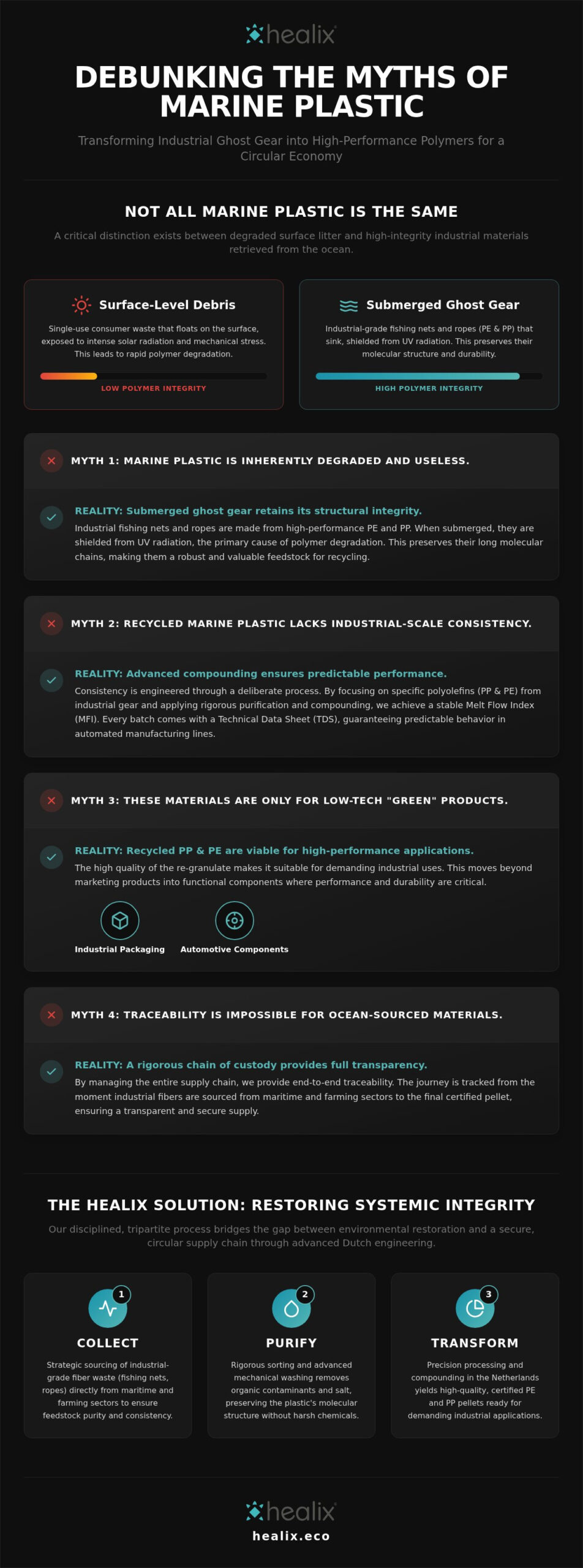
The assumption that all plastic retrieved from the ocean is useless sludge is a fundamental misunderstanding of polymer science. Marine plastic raw materials are not a monolith. While surface debris suffers from intense solar radiation and mechanical fragmentation, submerged industrial fiber waste exists in a different state of preservation. It’s vital to distinguish between “ocean-bound” plastic, which is waste collected near coastlines before it enters the water, and “marine-retrieved” plastic. Marine plastic pollution encompasses both, but their industrial utility varies wildly. Ghost gear, specifically discarded fishing nets and ropes, represents a high-integrity feedstock that has been unfairly grouped with brittle, single-use consumer waste.
The Reality of Ghost Gear Integrity
Fishing nets and ropes are engineered for the most demanding environments on Earth. These industrial fibers are designed for extreme tensile strength, abrasion resistance, and chemical stability. When these materials become ghost gear, they often sink or remain submerged, shielded from the primary driver of polymer degradation: ultraviolet radiation. Unlike a single-use plastic bottle that fragments quickly, these industrial-grade PE and PP fibers maintain their molecular chain length. This inherent durability allows us to treat them as a valuable resource. The ghost gear crisis is an environmental tragedy, but the material itself remains a robust candidate for circular manufacturing.
Mechanical Purification vs. Chemical Degradation
Restoring these materials requires a disciplined, tripartite approach: Collect, Purify, and Transform. We don’t need to break these polymers down to their monomeric state through energy-intensive chemical processes. Instead, advanced mechanical recycling focuses on preserving the existing polymer properties. This process relies on three distinct phases:
- Collect: Strategic sourcing of industrial-grade fiber waste directly from maritime and farming sectors to ensure feedstock purity.
- Purify: Rigorous sorting and mechanical washing to remove organic contaminants and salt without damaging the plastic’s molecular structure.
- Transform: Precision processing in the Netherlands that yields high-quality pellets ready for industrial use.
This methodology ensures that the final re-granulate retains the mechanical performance required for demanding applications like automotive components or durable packaging. By focusing on mechanical purification, we preserve the energy already invested in the original polymer. This creates a truly circular outcome that respects the material’s integrity while providing a solution-oriented path forward for global supply chains.
Myth 2: You Can’t Achieve Industrial-Scale Consistency with Marine Plastic
The primary objection to the use of marine plastic raw materials in automated manufacturing is variability. Procurement teams often fear that recycled polymers will exhibit inconsistent flow rates or mechanical failures, leading to costly downtime. This concern is valid when discussing unrefined, mixed ocean waste. However, industrial fiber waste from fishing and farming provides a remarkably predictable feedstock. By focusing on specific polyolefins like PP and PE, we eliminate the guesswork associated with post-consumer debris. Consistency isn’t an accident; it’s the result of a deliberate, tripartite methodology: rigorous feedstock selection, advanced mechanical purification, and target-oriented compounding.
Standardizing the Circular Supply Chain
Achieving industrial-grade quality requires a fundamental shift from waste management to raw material production. Every batch of our re-granulate undergoes extensive testing to generate comprehensive Technical Data Sheets (TDS). We prioritize the stabilization of the Melt Flow Index (MFI), ensuring that our recycled polymers behave predictably during injection molding or extrusion. Discussions surrounding the global governance of marine plastic pollution highlight the technical challenges of scaling these solutions, yet Dutch engineering has already bridged this gap. By implementing strict batch-to-batch controls, we provide manufacturers with the same reliability they expect from virgin resins.
Virgin vs. Recycled Marine Polymers
It’s a common misconception that recycled marine plastic is a “lesser” material. In reality, certified recycled PP and PE can match the performance of virgin polymers in numerous industrial contexts. When processed correctly, these materials retain critical mechanical properties:
- Tensile Strength: Industrial fibers are engineered for high-stress environments, and our mechanical recycling preserves this structural integrity.
- Impact Resistance: Precise compounding ensures that the final pellets can withstand the rigors of automotive and packaging applications.
- Durability: The molecular stability of submerged ghost gear allows for a long-lasting circular lifecycle.
Transitioning to these sustainable alternatives doesn’t require a compromise on quality. Finding a reliable circular HDPE supplier is the first step toward integrating these high-performance materials into your existing production lines. We invite you to explore our range of certified circular plastic pellets to see how consistency and sustainability coexist at scale.
Myth 3: Marine Plastic is Only Suitable for Low-Tech ‘Green’ Products
Reducing marine plastic to a “storytelling” material for consumer trinkets ignores its true industrial potential. While sunglasses and wristwatches serve as visible symbols of environmental awareness, they don’t address the massive volumes of waste requiring systemic intervention. High-quality marine plastic raw materials are now sophisticated enough to enter the most demanding supply chains. This transition from niche marketing to industrial-grade application is driven by the purity of the re-granulate produced through advanced mechanical recycling. By focusing on the structural integrity of industrial fiber waste, we provide materials that meet the rigorous specifications of global manufacturing.
The NOAA Marine Debris Program highlights the staggering scale of maritime waste, much of which consists of the high-performance polyolefins we recover. These aren’t degraded trash polymers; they’re the building blocks of modern logistics and infrastructure. When transformed into certified circular pellets, they provide the mechanical properties necessary for complex injection molding processes that virgin resins once dominated. This evolution allows manufacturers to pivot toward sustainability without sacrificing the structural performance of their product lines.
High-Performance Applications for PE and PP
The automotive sector is a primary beneficiary of this material evolution. Recycled PP and PE are increasingly utilized for interior components and under-the-hood parts where heat resistance and durability are non-negotiable. Beyond the automotive assembly line, these polymers are foundational to the logistics industry. We see them integrated into several critical areas:
- Industrial Logistics: Heavy-duty reusable pallets and crates that require high impact resistance and long-term structural stability.
- Durable Packaging: Utilizing recycled HDPE for packaging ensures that industrial containers meet safety and strength requirements for global shipping.
- Infrastructure: Long-life applications like drainage pipes and cable ducting that must survive decades of soil contact and pressure.
Meeting Strict Regulatory Standards
Trust in recycled materials is built on transparency and compliance. Our mechanical purification process is designed to ensure that every batch of re-granulate adheres to international safety standards, including REACH and RoHS. This level of rigor is essential for manufacturers who can’t risk supply chain contamination. In high-performance manufacturing environments, maintaining such standards often involves the use of specialized industrial chemicals, such as those described at elchemy.com, to ensure equipment hygiene and process integrity. By securing GRS (Global Recycled Standard) certification, we provide the documented proof of origin and quality that industrial partners demand. Industrial-grade circularity is the precise intersection of ecological restoration and high-level engineering. It’s a commitment to performance that ensures our recycled pellets don’t just solve an environmental crisis, but also fulfill a technical necessity.
The specter of greenwashing often haunts the procurement of sustainable polymers. Manufacturers fear that “marine-sourced” is merely a marketing label without a verifiable foundation. This skepticism is healthy. Without a clear paper trail, sourcing marine plastic raw materials can feel like a leap of faith that most brands simply can’t afford. However, the era of opaque supply chains is ending. Modern circular manufacturing utilizes a rigorous “Chain of Custody” model that tracks every gram of material from the moment it leaves the water until it reaches the production line. This level of transparency isn’t an optional luxury. It’s a prerequisite for the systemic integrity of global industries.
From Ghost Nets to Certified Pellets
Healix operates on a tripartite logic of traceability that ensures absolute clarity for our partners. This process is divided into three distinct, actionable phases: the Collection Point, the Processing Hub, and the Manufacturer. We start by documenting the specific maritime or farming origins of the industrial fiber waste. Once it arrives at our facility in the Netherlands, we record every stage of mechanical purification. Finally, the manufacturer receives a batch of high-quality pellets accompanied by a digital footprint of its journey. This methodical documentation transforms “waste” into a high-performance asset with a proven history, allowing companies to integrate these materials with total confidence.
The Value of Third-Party Verification
Relying on a supplier’s word isn’t enough in a high-stakes corporate environment. Third-party certifications like the Global Recycled Standard (GRS) and Ocean Bound Plastic (OBP) certification provide the external validation necessary to protect brands from reputational risk. These standards aren’t just checkboxes. They are rigorous frameworks that audit the social, environmental, and chemical impact of the entire supply chain. They ensure that the recycled PP and PE you use are exactly what they claim to be. For a more technical deep-dive into how these verified materials behave, you can consult our guide on recycled polypropylene granules. This level of verification bridges the gap between environmental ambition and industrial reality. It’s time to move beyond vague promises and embrace a data-driven circular future. Contact us today to secure your supply of certified circular plastic and lead the transition toward a cleaner manufacturing model.
The Healix Solution: Restoring Systemic Integrity
The global plastic crisis requires more than just awareness; it demands a radical restructuring of industrial supply chains. At Healix, we act as the vital link between environmental restoration and manufacturing necessity. This commitment to industrial-scale restoration is shared across various sectors; if your sustainability goals extend to complex wastewater treatment, you can learn more about QM Environmental International B.V. and their precision bioaugmentation techniques. By transforming discarded industrial fibers into high-performance marine plastic raw materials, we prove that circularity isn’t a distant ideal but a present-day reality. Our Dutch facility stands as a beacon of engineering excellence, where we redefine the lifecycle of polymers. We don’t just process waste. We restore systemic integrity to a fractured global model, turning a maritime tragedy into a solution for the world’s most demanding industries.
Our mechanical recycling process is a testament to the efficiency of modern technology. Unlike energy-heavy chemical alternatives, our mechanical approach preserves the polymer’s molecular structure while significantly reducing the total carbon footprint. Choosing our recycled PE and PP pellets allows manufacturers to lower their Scope 3 emissions without compromising on material performance. This isn’t a trade-off; it’s a strategic upgrade. Our technical benefits are defined by a commitment to three core principles:
- Precision: Utilizing advanced mechanical purification to remove contaminants while maintaining polymer chain length.
- Purity: Delivering certified re-granulate that meets REACH and RoHS standards for industrial safety.
- Performance: Ensuring that every batch of recycled PP and PE matches the mechanical properties of virgin resins for high-tech applications.
This methodology ensures that the energy already invested in the original polymer is preserved, maximizing the ecological and economic value of every kilogram of material we process.
Partnering for a Circular Future
Transitioning to a circular model is a collaborative journey that requires scientific rigor and visionary leadership. We work closely with global supply chains to integrate our marine plastic raw materials into existing production workflows. This partnership goes beyond simple procurement. We engage in collaborative material science and application testing to ensure our polymers perform perfectly in your specific manufacturing environment. Whether you’re developing automotive components or durable packaging, our team provides the technical expertise needed to navigate the complexities of recycled material integration. Manufacturers looking to further reduce costs and emissions can also explore how using recycled PP from industrial big bags as a sustainable feedstock for plastic production delivers verified carbon reduction alongside consistent polymer performance.
As we look toward the 2026 supply cycle, the window for securing high-quality, certified recycled fishing gear raw materials is narrowing. We invite procurement teams to move beyond the linear “take-make-waste” model and embrace a future of restoration and resilience. Healix acts as your professional partner in this necessary global movement. Together, we can turn the tide on plastic pollution and build a legacy of industrial responsibility for future generations. Secure your circular future today by partnering with a leader in mechanical polymer restoration.
Leading the Transition to Industrial Circularity
The transition toward a circular economy is no longer a distant vision; it’s a strategic imperative for the modern manufacturer. We’ve dismantled the myths that once characterized marine plastic raw materials as degraded or inconsistent. By prioritizing the structural integrity of industrial ghost gear and utilizing advanced Dutch mechanical recycling, we’ve unlocked a high-performance resource that rivals virgin polymers. This journey is defined by transparency, mechanical excellence, and a commitment to systemic change.
Manufacturers can now integrate GRS and OBP certified materials that safeguard both product quality and brand reputation. As a global industrial supply chain partner, Healix delivers the technical precision and certified pellets required to move from linear failure to circular success. It’s time to redefine the technical and ethical boundaries of your production lines. We don’t have to choose between profitability and the planet; we can achieve both through engineering rigor.
Secure your supply of certified marine plastic raw materials with Healix and join a movement dedicated to restoring our oceans through engineering excellence. The future of manufacturing is here; it’s circular, it’s certified, and it’s ready for your next innovation.
Frequently Asked Questions
What is the difference between ocean-bound plastic and marine plastic raw materials?
Ocean-bound plastic refers to land-based waste collected within 50 kilometers of a coastline before it enters the water. In contrast, marine plastic raw materials are retrieved directly from aquatic environments. This distinction is vital for manufacturing. While ocean-bound waste often includes degraded consumer debris, marine-retrieved materials like recycled fishing gear raw materials frequently maintain superior molecular integrity because they’ve been shielded from UV radiation while submerged in the deep ocean.
Can marine plastic raw materials be used in food-contact packaging?
Currently, mechanically recycled marine plastic raw materials aren’t certified for direct food-contact applications. Regulatory frameworks like EFSA and the FDA require specific decontamination levels that mechanical processes for industrial fiber waste don’t prioritize. Instead, these high-quality pellets excel in non-food packaging, automotive components, and logistics infrastructure. They provide the mechanical strength required for industrial circularity without the regulatory complexities associated with direct food contact safety standards.
How do you ensure the mechanical properties of recycled PP and PE are consistent?
Consistency is achieved through target-oriented compounding and rigorous batch testing. We focus on industrial fiber waste, such as fishing nets, which provides a more predictable feedstock than mixed consumer debris. Every batch undergoes mechanical evaluation to verify the Melt Flow Index and tensile strength. This ensures that the recycled PP and PE pellets meet the precise Technical Data Sheets required for automated manufacturing and high-performance industrial applications.
What certifications should I look for in a marine plastic supplier?
You should prioritize suppliers holding Global Recycled Standard (GRS) and Ocean Bound Plastic (OBP) certifications to verify origin and supply chain integrity. These third-party standards ensure the material is legitimately sourced and processed under ethical conditions. Additionally, compliance with REACH and RoHS is essential for industrial manufacturers. These certifications protect your brand from reputational risk and ensure the polymers meet global safety regulations for high-performance use.
Is marine plastic more expensive than virgin plastic for industrial use?
The cost of marine plastic raw materials reflects the complex logistics of retrieval and the advanced mechanical purification required to restore polymer integrity. While it may carry a premium over virgin resins, it provides significant value through carbon footprint reduction and brand resilience. Many industrial partners view this as a strategic investment. It secures the supply chain against future carbon taxes and meets the growing consumer demand for environmental stewardship.
What types of industrial waste does Healix specifically process?
Healix specifically targets industrial fiber waste from the maritime and agricultural sectors. This includes discarded fishing nets, ropes, and farming fibers made from high-quality PP and PE. By focusing on these specific industrial streams rather than mixed consumer waste, we ensure a higher purity level in our re-granulate. This specialization allows us to bridge the gap between environmental restoration and the technical requirements of high-performance industrial manufacturing.
How does mechanical recycling impact the carbon footprint of plastic production?
Mechanical recycling significantly lowers the carbon footprint compared to both virgin plastic production and energy-heavy chemical recycling. By preserving the existing polymer structure instead of breaking it down into monomers, the process consumes far less energy. This allows manufacturers to reduce their Scope 3 emissions while utilizing high-quality pellets. It’s a solution that respects the energy already invested in the original polymer, maximizing both ecological and economic value. For manufacturers seeking additional pathways to verified carbon reduction, understanding how recycled PP from industrial big bags serves as a sustainable feedstock for plastic production offers a complementary strategy for lowering Scope 3 emissions across the supply chain.
Can marine plastic pellets be used in existing injection molding machinery?
Yes, our certified circular plastic pellets are designed as a drop-in solution for existing injection molding and extrusion machinery. Because we stabilize the Melt Flow Index and ensure consistent mechanical properties, manufacturers don’t need to invest in new equipment. This ease of integration allows global supply chains to transition from linear to circular models without disrupting current production efficiency or requiring significant capital expenditure for machinery modifications.