Ghost gear isn’t just an environmental catastrophe; it’s one of the most underutilized industrial feedstocks in the global supply chain. For years, the difficulty of sourcing consistent, high-quality recycled fishing gear raw materials has hindered large-scale circular adoption. You understand that the transition to a sustainable future requires more than just good intentions. It demands materials that meet rigorous technical specifications, ensure total supply chain transparency, and eliminate the risk of contaminants. The scale of the marine plastic crisis is immense, but the industrial opportunity it presents is equally significant.
Discover how discarded fishing nets and ropes are being re-engineered into high-quality, certified PE and PP raw materials for global manufacturing. We move beyond the crisis to focus on the solution. This guide breaks down the transformation process into three critical phases: collection, purification, and pelletization. You’ll learn how to identify certified suppliers of recycled PE and PP while building a robust business case for circular plastic integration. We aren’t just cleaning the ocean. We’re redefining the integrity of industrial production for future generations.
Key Takeaways
- Define the distinction between general ocean-bound plastics and ghost gear to leverage the high-performance potential of discarded marine fibers.
- Explore the mechanical recycling process that uses a tripartite logic of collection, purification, and transformation to ensure industrial-grade purity.
- Compare the mechanical properties of recycled fishing gear raw materials against virgin polymers to validate their performance in high-demand manufacturing.
- Protect your supply chain from greenwashing by prioritizing third-party certifications such as GRS and Ocean Bound Plastic for all circular inputs.
- Follow a structured roadmap to audit your existing polymer requirements and transition to certified recycled PE and PP pellets with confidence.
What are Ocean Bound Plastic Raw Materials? Defining the Resource
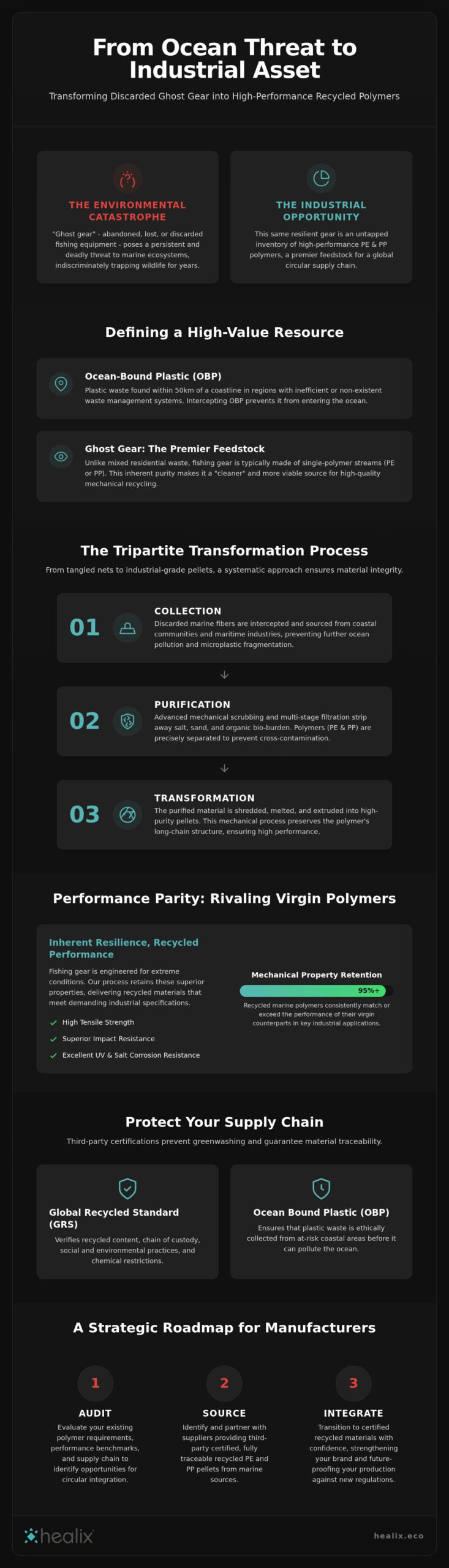
The global plastic crisis is often framed as an insurmountable failure. We see it differently. Ocean-bound plastic (OBP) represents a massive, untapped inventory of high-performance polymers that are currently drifting toward ecological destruction. We view this resource through a tripartite lens: identification of high-value streams, interception before fragmentation, and integration into the global supply chain. These materials, primarily Polypropylene (PP) and Polyethylene (PE), are the backbone of the global maritime industry. When we recover these fibers, we aren’t just cleaning water. We’re securing the building blocks of a circular economy.
Ocean-bound plastic refers specifically to plastic waste located within 50km of a coastline where waste management is absent or inefficient. Within this category, Ghost nets and other fishing gear stand out as the most viable candidates for industrial transformation. Unlike mixed household waste, fishing gear is often composed of single-polymer streams. This inherent purity makes them the premier source for recycled fishing gear raw materials. By moving from linear disposal to systemic restoration, we can transform a planetary threat into a high-performance industrial feedstock.
Ghost Gear vs. Abandoned, Lost, or Discarded Fishing Gear (ALDFG)
Standardizing terminology is the first step toward systemic restoration. Environmental bodies distinguish between “ghost gear,” which continues to fish indiscriminately, and ALDFG, which encompasses all abandoned, lost, or discarded gear. For manufacturers, industrial fiber waste from these sources is a “cleaner” feedstock than residential waste. It hasn’t been contaminated by household organic matter or complex multi-layer packaging. By intercepting these materials, we prevent microplastic fragmentation and turn a marine threat into a certified industrial input. It’s a pragmatic approach to a complex ecological problem.
The Economic Potential of Marine Plastic Circularity
Linear disposal is an expensive legacy of the past. Landfilling discarded nets costs money and wastes energy. Transformation creates value. As global regulations move toward mandatory recycled content, the demand for high-purity polymers is accelerating. Manufacturers who integrate recycled PE and PP pellets today aren’t just meeting compliance. They’re building brand equity. They’re proving that industrial success can coexist with ecological health. This shift from waste management to raw material production is the bridge to a truly circular future. It’s a transition that replaces the cost of cleanup with the value of creation.
The Transformation Process: From Discarded Nets to Certified Pellets
Fishing gear is engineered for extreme resilience. It’s designed to withstand UV exposure, salt corrosion, and immense physical tension for years. While these traits make “ghost gear” a persistent threat to marine life, they also make it a superior source for recycled fishing gear raw materials. The challenge lies in the complexity of the fibers. Transforming a tangled, bio-fouled net into a high-purity polymer requires more than simple processing. It demands a systematic approach that respects the technical integrity of the original material.
We employ a tripartite logic to bridge the gap between waste and industry: Collection, Purification, and Transformation. By focusing on mechanical recycling rather than chemical alternatives, we preserve the polymer’s long-chain molecular structure. This method ensures that the resulting pellets maintain the tensile strength and impact resistance required for demanding applications. From automotive components to high-end office furniture made with recycled fishing nets, the goal is consistent, industrial-grade performance that rivals virgin resin.
Advanced Mechanical Purification Techniques
Marine gear arrives coated in salt, sand, and organic bio-burden. Standard washing isn’t enough. Our purification phase uses advanced mechanical scrubbing and multi-stage filtration to strip away contaminants at a microscopic level. We precisely separate Polypropylene (PP) from Polyethylene (PE) to prevent cross-contamination, which is the primary cause of material failure in recycled plastics. This rigorous sorting ensures that every batch of re-granulate meets the strict purity standards expected by global procurement officers. It’s a methodical restoration of the polymer’s original potential.
Extrusion and Granulation: Creating the Raw Material
The final stage of the arc is the most critical for manufacturing compatibility. Purified flakes are fed into high-precision extruders where temperature control is paramount. We maintain thermal stability to prevent polymer degradation, ensuring the material remains robust through multiple heat cycles. Extrusion is the industrial method of melting cleaned polymer flakes and pushing them through a specialized die to form standardized, high-quality pellets for manufacturing. These uniform pellets allow for seamless integration into existing production lines without requiring expensive machinery adjustments. If you’re ready to stabilize your supply chain with high-purity inputs, you can view our certified circular plastic specifications to find the right match for your technical needs.
Evaluating Quality: Recycled Marine Plastic vs. Virgin Polymers
Many procurement officers fear that circular materials are inferior to virgin resins. This is a misconception that hinders systemic change. High-quality recycled fishing gear raw materials can match the mechanical properties of virgin polymers when processed with industrial precision. We analyze three key metrics to prove this: tensile strength, impact resistance, and melt flow index. Modern mechanical recycling doesn’t merely “downcycle” waste. It restores utility by removing the microscopic contaminants that cause structural failure in lower-tier recycled products.
The urgency of this transition is clear. Abandoned nets lead to ghost fishing, a process that destroys marine ecosystems while the polymers degrade under harsh UV exposure. However, by intercepting these materials before they fragment into microplastics, we can salvage their inherent industrial value. Integrating marine plastic raw materials into your factory floor isn’t a compromise on quality. It’s a strategic upgrade that aligns your production with the demands of a circular economy.
Industrial Applications for Recycled PP and PE
Mass-market industrial applications are the true test of recycled polymer integrity. Automotive manufacturers now use these purified polymers for durable interior panels and under-the-hood components that must withstand constant vibration. In the logistics sector, companies are building a circular HDPE supplier ecosystem to produce high-impact pallets and crates. Consumer goods, from heavy-duty suitcases to sustainable logistics pallets, benefit from the material’s resilience. These aren’t niche fashion items. They’re high-volume solutions that demand consistent, virgin-like performance across every production run.
Standardization and Batch Consistency
Consistency is the bedrock of industrial manufacturing. Professional recyclers eliminate the “batch-to-batch” variance that often plagues the recycled market by providing detailed Technical Data Sheets (TDS) for every shipment. We employ rigorous testing protocols for recycled polypropylene granules to ensure that melt flow and density remain within tight tolerances. This level of transparency allows your engineers to maintain production speeds without constant machinery recalibration. Trust is built through data. By providing transparent specifications, we enable manufacturers to switch from virgin to circular inputs without risking production downtime or product failure.
Traceability and Certification: Ensuring Supply Chain Integrity
Greenwashing is the single greatest threat to the circular economy. For global corporations, the risk of unverified claims in the marine plastic supply chain is a liability they cannot afford. Procurement must move beyond marketing narratives to demand hard data. Trust in recycled fishing gear raw materials is built on three pillars: verify origins, validate processing standards, and document final material composition. Without this tripartite verification, circularity remains a performative gesture rather than a systemic solution. Certified materials don’t just protect the environment; they protect your brand’s integrity and simplify the complex demands of ESG reporting.
The regulatory landscape is tightening. Major revisions to the Ocean Bound Plastic (OBP) certification standards are scheduled for completion before September 2026, signaling a shift toward even more rigorous auditing. We embrace this evolution. By utilizing third-party certifications like GRS and CCRN, we provide the transparency needed for global supply chains. These frameworks ensure that every kilogram of plastic removed from the coastline is accounted for, creating a clear chain of custody from the ocean to the factory floor. This level of scrutiny turns transparency into a powerful competitive advantage.
Global Recycled Standard (GRS) and its Importance
GRS certification is the gold standard for circular polymers. It proves that the recycled content is exactly what the supplier claims it to be while ensuring that strict social and environmental standards were met during collection. For manufacturers, holding a recycled HDPE packaging certificate is more than a badge. It’s a guarantee of ethical sourcing and technical purity. It confirms that the material has been tracked through every stage of the recycling arc, providing the necessary evidence for life cycle assessments and regulatory compliance. GRS turns vague sustainability goals into measurable, auditable results.
Transparency as a Competitive Advantage
Data is the currency of the modern industrial economy. Manufacturers now require “source-to-pellet” documentation to satisfy both investors and consumers. We provide the granular data needed for detailed life cycle assessments, allowing you to quantify the exact carbon reduction of your circular shift. There is an accelerating demand for recycled polypropylene for circular manufacturing that comes with proven origins. This level of detail eliminates the “degradation myth” by proving the material’s history and performance. If you are ready to secure a transparent, high-performance feedstock, you can request a technical sample of our certified circular plastic to begin your transition today.
Implementing Circular Raw Materials: A Strategic Roadmap for Manufacturers
The integration of circular polymers into existing industrial lines is no longer a peripheral concern. It’s the central challenge of the next decade. Success requires a methodical, four-step progression from assessment to scale. First, audit your current polymer usage to identify substitution candidates. Many structural components that currently rely on virgin resin are ideal candidates for high-purity recycled fishing gear raw materials. Second, partner with a high-volume, certified recycler like Healix to ensure supply chain stability. We provide the technical specifications and volume guarantees necessary for industrial-scale operations.
Once a partner is secured, the third step is prototyping. You must test material performance in existing molds to verify shrinkage, flow rates, and cycle times. For companies looking to accelerate this stage, resources like vprint3d.com.hk can provide the necessary prototyping support. This scientific rigor ensures that the transition doesn’t compromise production efficiency. Finally, communicate the circular impact. Transparency in your supply chain is a powerful asset for building stakeholder trust and consumer loyalty. By following this roadmap, you transform a complex environmental challenge into a predictable, high-performance manufacturing advantage. It’s a strategic shift from resource depletion to systemic restoration.
Manufacturers often fear that non-virgin polymers will require a total facility overhaul. This is a misconception. Most modern injection molding machines can handle significant recycled content percentages with minor calibration. We work closely with your team to manage color consistency and thermal stability, ensuring the transition is seamless. Success depends on deep collaboration between your R&D department and your material supplier. We provide the technical expertise to bridge the gap between environmental recovery and industrial precision, ensuring that your production remains robust and reliable. Manufacturers looking to further reduce costs and emissions can also explore how using recycled PP as a sustainable feedstock for plastic production delivers verified carbon reduction alongside long-term price stability.
The Future of Circular Manufacturing
The era of small-scale pilot projects is ending. The next phase is full-scale, global production. Scaling requires a partner who understands the technical demands of the factory floor as deeply as the global context of the plastic crisis. We act as that bridge. By securing a sustainable polymer future, we enable manufacturers to thrive in a world of increasing regulation and ecological scarcity. It’s time to move beyond the linear model of the past. Partner with Healix for your circular plastic needs and lead the transition to a truly systemic restoration of our planet’s resources.
Securing the Future of Circular Manufacturing
The transition from a linear “take-make-waste” model to a restorative industrial cycle is no longer a choice. It’s a strategic imperative. We’ve established that high-purity recycled fishing gear raw materials are not merely a sustainable alternative but a technically viable feedstock that rivals virgin resins in performance. By leveraging advanced mechanical recycling and rigorous third-party certifications, manufacturers can now eliminate supply chain risks while meeting the urgent demands of global plastic regulations. The path from discarded nets to industrial-grade pellets is clear, transparent, and ready for scale.
Our work in the Netherlands serves as a global hub for this transformation, combining technical precision with logistical expertise. We provide the certified recycled PE and PP pellets needed to stabilize your circular supply chain without compromising on quality. The era of industrial-scale ocean restoration has arrived, and it’s powered by innovation rather than compromise. Join the movement toward circularity with Healix certified raw materials and begin your journey toward a systemic, sustainable legacy. Together, we can turn the tide on plastic waste and build a future that respects both our oceans and our industry.
Frequently Asked Questions
What is the difference between ocean plastic and ocean-bound plastic?
Ocean plastic refers to waste already drifting in the marine environment. Ocean-bound plastic (OBP) is waste located within 50km of a coastline where waste management is absent or inefficient. We focus on OBP because it’s intercepted before it fragments into microplastics or sinks to the seabed. This preventive approach ensures the material remains technically viable for industrial reuse, avoiding the extreme UV degradation found in plastics that have floated in open water for years.
Can recycled fishing nets really be used for high-quality industrial parts?
Yes, recycled fishing nets are ideal for high-performance industrial applications because they’re made from high-strength Polypropylene (PP) and Polyethylene (PE). When processed correctly, these recycled fishing gear raw materials match the mechanical properties of virgin resin. Industrial sectors like automotive and logistics use these polymers for components requiring high tensile strength and impact resistance. Modern mechanical recycling restores the material’s utility, ensuring it meets the rigorous specifications of global manufacturing lines without compromising structural integrity.
What certifications should I look for in a recycled plastic supplier?
Look for third-party certifications that validate both the material source and the ethical standards of the supply chain. The Global Recycled Standard (GRS) and Ocean Bound Plastic (OBP) certification are critical for verifying recycled content and environmental compliance. These frameworks provide the auditable data required for ESG reporting and life cycle assessments. Choosing a supplier with these credentials ensures total transparency and protects your brand from the liabilities associated with greenwashing in the circular economy.
Is recycled PP from fishing gear more expensive than virgin plastic?
The cost of recycled PP is influenced by market dynamics, energy prices, and regulatory mandates rather than a fixed premium. While virgin polymer prices fluctuate with global oil markets, recycled materials offer long-term price stability and regulatory compliance. In many regions, the transition to circular inputs is driven by rising landfill costs and carbon mandates. Manufacturers find that the long-term brand value and ESG benefits often outweigh the initial investment in sustainable feedstock for plastic production.
How does Healix ensure the purity of its recycled PE and PP pellets?
We employ a tripartite logic of collection, purification, and transformation to ensure maximum purity. Our process utilizes advanced mechanical scrubbing to remove organic bio-burden and salt before multi-stage filtration separates mixed-polymer streams. Every batch is tested against a Technical Data Sheet (TDS) to verify its melt flow index and density. This methodical approach eliminates the contaminants that typically cause structural failure, resulting in high-quality recycled fishing gear raw materials ready for demanding industrial use.
What industries benefit most from using ocean-bound plastic raw materials?
The automotive, packaging, and consumer goods industries see the most significant benefits from integrating circular polymers. Automotive manufacturers use these durable materials for interior panels, while logistics companies produce high-impact pallets and crates from recycled HDPE. Consumer goods brands use the material for items like luggage, sustainable electronics, and professional equipment cases like those from ProX. These sectors require materials with high structural integrity and consistent batch-to-batch performance, which our certified mechanical recycling process provides through rigorous technical standardization and testing.
Most modern injection molding machines can process high percentages of recycled content with minimal adjustments. While using 100% recycled material is possible, many manufacturers start with a blend to stabilize cycle times and manage color consistency. We provide technical support to help your R&D team calibrate machinery for specific flow rates and thermal stability. Success depends on selecting a high-purity pellet that fits your existing molds, ensuring a seamless transition from virgin to circular inputs.