As of August 12, 2026, the EU Packaging and Packaging Waste Regulation is no longer a distant target; it’s a rigorous operational mandate for every industrial player. You understand that simply labeling a product as “recycled” isn’t enough to satisfy regulators or your own quality standards. The era of supply chain opacity is ending. It’s being replaced by a demand for absolute accountability and verifiable impact. Success in the sustainable sourcing of recycled plastic raw materials now requires a sophisticated balance of environmental ethics, regulatory precision, and technical excellence.
This guide provides the framework you need to secure high-integrity circular polymers while ensuring 100% traceability from the waste source to the final pellet. We’ll show you how to mitigate the risks of inconsistent material quality and meet corporate sustainability goals without sacrificing mechanical properties. We break this transition into three phases: verifying feedstock integrity, ensuring processing transparency, and validating final performance. By the end of this guide, you’ll have a clear roadmap to navigate the complex landscape of certified PE and PP, transforming your supply chain from a liability into a verifiable engine of circularity.
Key Takeaways
- Understand how the 2026 regulatory landscape transforms the sustainable sourcing of recycled plastic raw materials from a corporate choice into a non-negotiable operational requirement.
- Identify feedstock integrity as the primary driver of material performance, allowing you to secure high-performance pellets that rival virgin plastic specifications.
- Navigate the terminology of recycled polymers to effectively distinguish between ocean-bound, post-consumer, and high-integrity industrial waste sources.
- Apply a strategic five-pillar procurement framework to transition your supply chain from a cost-first model to a high-integrity, circular-first partnership.
- Explore the “Ghost Gear to Granulate” methodology to achieve total traceability and meet stringent EU recycling requirements with certified circular PE and PP.
The Imperative for Sustainable Sourcing of Recycled Plastic Raw Materials in 2026
Sustainable sourcing is no longer a peripheral corporate social responsibility initiative; it’s a core strategic imperative. It’s the disciplined procurement of materials that minimize ecological footprints while upholding social equity across the entire value chain. In 2026, the global market has moved past superficial sustainability into an era of radical accountability. Procurement teams now recognize that the foundation of a circular economy isn’t the final product, but the raw material choice itself. You can’t build a circular future on a linear foundation. We view this transition through a tripartite logic: Environmental Restoration to heal damaged ecosystems, Supply Chain Integrity to ensure ethical transparency, and Industrial Viability to maintain mechanical performance. Success in the sustainable sourcing of recycled plastic raw materials requires balancing these three pillars without compromise.
The Crisis of Linear Sourcing Models
Traditional procurement models relied on virgin plastic, which remains carbon-intensive and ecologically destructive. Conventional waste management often fails to bridge the gap between discarded waste and high-quality industrial inputs. This failure has created a “transparency gap” where manufacturers don’t know the true origin or chemical history of their polymers. Understanding the process of plastic recycling is essential to see why standard collection often yields degraded materials. Linear models are breaking under the weight of their own inefficiency. They’re incapable of providing the high-purity feedstock required for modern industrial applications. When supply chains remain opaque, businesses inherit the environmental liabilities of their suppliers, creating significant brand and operational risks.
Regulatory Drivers: EU Plastic Tax and Beyond
The financial landscape has shifted permanently. The EU Packaging and Packaging Waste Regulation (PPWR), which became applicable on August 12, 2026, mandates specific recycled content targets across all member states. Utilizing certified EU plastic tax compliance materials is now a prerequisite for market access. Failure to source certified circular polymers introduces massive financial risk. Beyond the EU, the UK’s Plastic Packaging Tax remains a significant factor, while global mandates in the automotive sector are forcing a move toward 100% traceability. If you can’t prove the origin of your pellets, you’re exposed to both legal penalties and brand erosion. High-integrity sourcing is the only way to insulate your business from these escalating costs and ensure long-term compliance in a transparent, regulated market.
Feedstock Integrity: Why the Origin of Recycled Polymers Dictates Product Quality
Feedstock Integrity is the single most critical predictor of circular performance. It determines whether a polymer can withstand the rigors of industrial manufacturing or if it will fail under mechanical stress. While many procurement strategies focus on volume, true leaders prioritize the origin. Degraded post-consumer waste from household streams often suffers from complex thermal histories and cross-contamination. In contrast, industrial fiber waste offers a clean, high-tenacity starting point. By focusing on the sustainable sourcing of recycled plastic raw materials from specific, high-integrity streams, manufacturers can achieve mechanical properties that rival virgin resins. This approach eliminates the guesswork from circular design. It ensures that every pellet carries the structural heritage of its original, high-performance application.
The Ghost Gear Advantage: Fishing Nets and Ropes
Maritime materials represent the peak of polymer engineering. Fishing nets and ropes are designed to survive extreme tension, UV exposure, and saltwater immersion. This inherent strength makes them the ideal feedstock for recycled polypropylene granules that require high impact resistance and durability. Retrieving this “ghost gear” serves a dual purpose. It cleanses our oceans of lethal debris while providing a consistent, high-performance input for land-based industries. We don’t just recycle; we restore. This transition from marine hazard to industrial asset represents the gold standard of circularity. It moves beyond simple waste management into the realm of ecosystem regeneration, ensuring that the materials we use today contribute to the health of the planet tomorrow.
Mechanical Recycling vs. Chemical Recycling
The method of transformation is as vital as the source itself. Mechanical recycling stands as the most energy-efficient path to purity. It uses physical processes to shred, wash, and regranulate fibers without breaking the molecular bonds of the polymer. This preservation of molecular weight is crucial for industrial PE and PP applications where structural integrity is non-negotiable. Chemical recycling, while useful for highly contaminated mixed streams, often carries a significantly higher carbon footprint and intensive energy demand. Following standards like the APR PCR Certification helps verify that these processes meet rigorous industry benchmarks for quality and transparency. By selecting mechanical purification, you reduce Scope 3 emissions while maintaining the structural integrity of your materials. It’s a cleaner, more direct route to high-performance circularity. You can explore our range of certified circular polymers to see this Dutch engineering precision in practice.
Navigating the Spectrum of Recycled Plastics: From Ocean-Bound to Ghost Gear
The market for recycled polymers is flooded with terminology that often obscures more than it clarifies. Success in the sustainable sourcing of recycled plastic raw materials requires a precise understanding of these categories. Labels like “Ocean Bound,” “Post-Consumer,” and “Post-Industrial” don’t just describe geographic origins. They indicate the potential for contamination, the degree of polymer degradation, and the overall structural integrity of the final pellet. Navigating this landscape requires a three-step evaluation: identify the waste source, verify the collection method, and validate the certification level. It’s essential to utilize a recycled ocean plastic certification comparison to distinguish between materials collected from beaches and those retrieved directly from the sea as ghost gear. While beach-recovered plastic often suffers from severe UV damage, industrial maritime waste like fishing nets offers a much higher level of purity and mechanical strength.
Post-Consumer Recycled (PCR) vs. Post-Industrial Recycled (PIR)
Misconceptions often lead procurement teams to believe that PCR is the only path to true sustainability. While PCR is vital for global circularity, it often lacks the consistency required for high-precision injection molding due to the volatility of household waste streams. To responsibly source post-consumer recycled plastic, manufacturers must implement rigorous testing to account for fluctuating melt flow rates. Conversely, Post-Industrial Recycled (PIR) materials, specifically those derived from industrial fiber waste, provide a predictable and high-quality alternative. These materials allow you to close the loop on complex supply chains without the quality risks inherent in consumer collection systems. They offer a reliable bridge between environmental responsibility and industrial performance, ensuring your production lines remain efficient and your products remain durable. For businesses looking to optimize their broader recycling efforts, OC Recycling offers comprehensive solutions for commercial accounts.
Traceability: The New Gold Standard in Sourcing
Transparency is the only defense against greenwashing in a hyper-regulated market. The “Chain of Custody” model has become the standard for verifying that what you buy is what you get. Third-party certifications like the Global Recycled Standard (GRS) or OceanCycle provide the necessary oversight to validate claims of origin. These frameworks ensure that every kilogram of plastic is accounted for from the moment of collection to the final granulate. Utilizing certified circular polymers eliminates the risk of regulatory non-compliance and builds long-term brand trust. In a market where 54% of US consumers now choose products based on sustainable packaging, according to the Shorr 2025 report, your ability to prove material origin is a competitive necessity. Traceability doesn’t just manage risk; it secures your market position by providing the data-backed proof that modern regulators demand. Understanding the full scope of recycled plastic supply chain transparency is essential to separating verifiable claims from marketing noise and ensuring your procurement decisions hold up to regulatory scrutiny.
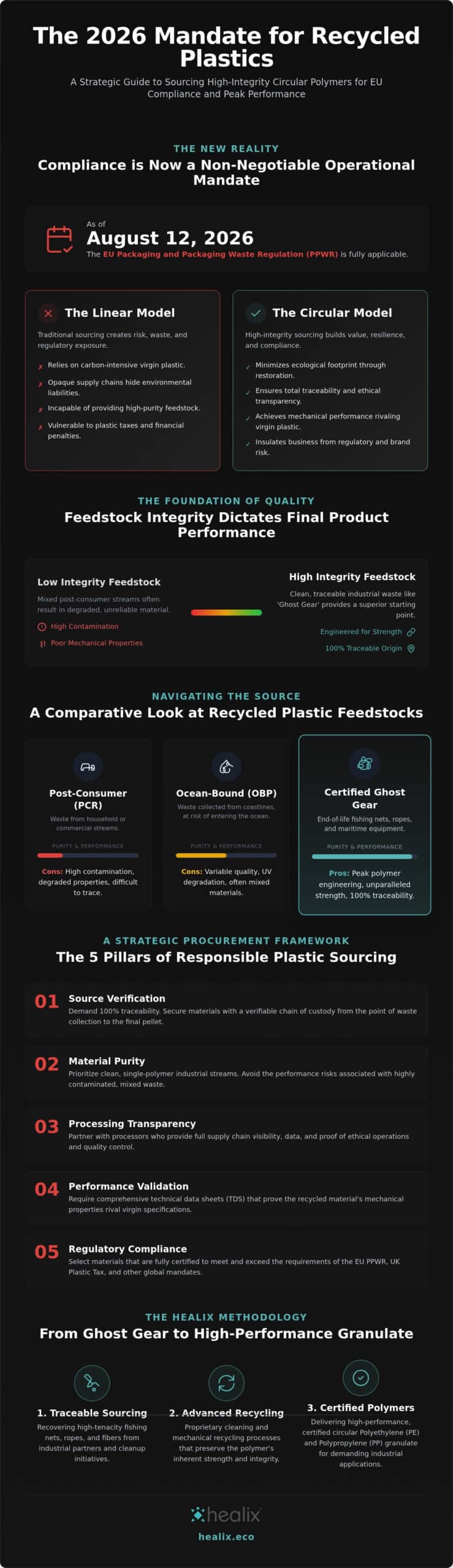
A Strategic Procurement Framework: 5 Pillars of Responsible Plastic Sourcing
The shift from “lowest price” to “highest integrity” marks the maturation of the circular economy. For decades, procurement teams treated recycled polymers as a simple commodity. In 2026, this approach is a significant strategic liability. High-performance manufacturing demands a rigorous framework to ensure that the sustainable sourcing of recycled plastic raw materials doesn’t compromise production uptime or product safety. The most common objection—performance inconsistency—is solved not by better testing, but by better sourcing. When you move from transactional buying to strategic partnerships, you gain visibility into the molecular history of your feedstock. This transition creates a resilient supply chain capable of meeting the demands of the future.
Pillars 1 & 2: Feedstock Verification and Certification
Before onboarding a circular HDPE supplier or PP partner, you must audit the origin of the raw waste. Don’t settle for self-reported data; demand third-party verification that tracks the journey from collection to granulate. Non-negotiable certifications like GRS or OceanCycle are essential for 2026 regulatory compliance and brand protection. Certified circularity is the intersection of rigorous auditing and technical excellence. It’s the only way to ensure your materials aren’t just “recycled” but are truly restorative and compliant with the latest EU mandates.
Pillars 3 & 4: Mechanical Performance and LCA Data
Industrial applications require precise technical specifications that mirror virgin resin benchmarks. You need guaranteed Melt Flow Index (MFI) and Tensile Strength values to maintain manufacturing efficiency. Request a comprehensive Life Cycle Assessment (LCA) from every supplier to validate their environmental claims. This data is your most powerful tool for justifying sourcing decisions to stakeholders and investors. Carbon footprint data allows you to quantify the environmental benefits of your procurement, moving the conversation from a cost-center to a value-generator for the entire organization.
Pillar 5: Security of Supply and Scalability
A sustainable material is useless if it’s unavailable. Evaluate your supplier’s capacity to meet global manufacturing volumes as your production scales. A strategically positioned supply chain—like those utilizing Dutch engineering precision—reduces logistical risks and ensures consistent lead times. Finally, assess their commitment to continuous innovation and R&D. The best partners aren’t just selling you pellets today; they’re developing the high-performance circular solutions you’ll need for the next decade. To secure your supply chain and meet these rigorous standards, source high-quality recycled pellets that provide both performance and peace of mind.
Healix: Transforming Industrial Plastic Waste into High-Performance Circular Solutions
Healix stands at the forefront of the “Ghost Gear to Granulate” movement, acting as a bridge between marine restoration and industrial innovation. We’ve redefined the sustainable sourcing of recycled plastic raw materials by focusing on the most challenging yet structurally superior waste streams: discarded fishing nets and industrial ropes. Our methodology follows a rigorous, tripartite logic: Collection of high-tenacity fiber waste, Purification through advanced mechanical processes, and Transformation into high-purity polymers. This systematic approach ensures that every ton of material diverted from the ocean becomes a high-performance asset for the automotive, consumer goods, and packaging sectors. For manufacturers of specialized equipment like SoftplayToys4kids, these materials offer the durability and safety required for high-use products. We don’t just provide pellets; we offer a pathway to systemic change, inviting manufacturers to replace linear liabilities with circular certainties.
Our state-of-the-art mechanical recycling facility in the Netherlands represents the pinnacle of industrial precision. We’ve engineered a process that specifically targets the complexities of industrial fibers, ensuring our PE and PP re-granulate meets the most exacting technical specifications. This “zero compromise” approach means manufacturers no longer have to choose between environmental responsibility and mechanical performance. By maintaining the molecular integrity of the polymer chains, we deliver recycled plastic that functions seamlessly on existing production lines. Our Dutch engineering heritage drives us to achieve a level of consistency that was once thought impossible for recycled polymers, providing a reliable foundation for the entire value chain.
Join the Movement: From Sourcing to Systemic Change
Procurement is a powerful lever for planetary health. When you choose mission-driven sourcing, you’re not just buying a raw material; you’re funding the removal of lethal ghost gear from fragile marine ecosystems. Every ton of Healix material represents a tangible reduction in ocean plastic pollution and a significant decrease in carbon intensity compared to virgin alternatives. We believe that the transition to a circular economy requires bold, collaborative action between innovators and industry leaders. It’s time to move beyond incremental goals and embrace a future where industrial growth and ecological restoration are inextricably linked. We invite you to partner with Healix for your sustainable sourcing needs and join us in redefining the ethical boundaries of global manufacturing.
Securing the Future of Circular Manufacturing
The transition to a circular economy is no longer a theoretical pursuit; it’s a technical and regulatory necessity. We’ve established that the integrity of your feedstock dictates the quality of your output. By adopting a rigorous five-pillar procurement framework, you can move beyond the transparency gap and ensure total compliance with evolving global mandates. Mastering the sustainable sourcing of recycled plastic raw materials is the most significant step your organization can take toward systemic environmental restoration. Healix provides the precision required for this shift, offering 100% Dutch-engineered mechanical recycling to produce certified GRS and OceanCycle polymers. Our high-integrity pellets are already trusted by global leaders in the automotive and consumer goods sectors to deliver performance without compromise. It’s time to transform your supply chain into a verifiable force for good. Secure your supply of certified circular polymers with Healix. Together, we can restore the integrity of our planet while advancing the standards of modern industry.
Frequently Asked Questions
What is the most sustainable way to source recycled plastic raw materials?
The most sustainable method is to prioritize materials with a verified industrial origin and a low carbon footprint. You should look for feedstocks like ghost gear that provide environmental restoration while offering high material purity. This approach ensures the sustainable sourcing of recycled plastic raw materials by closing the loop on specific, high-integrity streams rather than relying on mixed, degraded household waste. It’s a strategic move that balances ecological health with industrial viability.
How can I verify the traceability of recycled plastic pellets?
You verify traceability by demanding a robust Chain of Custody model supported by third-party audits. Reliable suppliers provide documentation that tracks the polymer from the initial waste collection point through the purification and regranulation phases. Look for certifications such as GRS or OceanCycle that validate these claims. This level of transparency is essential to eliminate greenwashing risks and ensure that every batch of material meets the rigorous standards required for modern industrial applications.
What are the main differences between post-consumer and post-industrial recycled plastic?
Post-consumer recycled (PCR) plastic originates from household waste, while post-industrial recycled (PIR) plastic comes from manufacturing or industrial streams like fishing nets. PIR often provides superior consistency and higher mechanical strength because it hasn’t been subjected to the same level of contamination and degradation as consumer waste. For high-precision manufacturing, PIR offers a more predictable melt flow index, which is critical for maintaining production efficiency without compromising the structural integrity of the final product.
Will recycled plastic raw materials affect the mechanical properties of my product?
Recycled materials don’t have to degrade performance if you select high-integrity feedstocks. While some recycled pellets suffer from reduced tensile strength, industrial-grade re-granulate derived from high-tenacity fibers can match the specifications of virgin resins. Success depends on the sustainable sourcing of recycled plastic raw materials that have been processed using advanced mechanical recycling. This technology preserves polymer chains, ensuring that your final product maintains its required durability and impact resistance across every production batch.
Which certifications should I look for when sourcing circular polymers?
You should prioritize certifications that offer both environmental and technical validation. Key standards include:
- Global Recycled Standard (GRS) for social and environmental processing requirements.
- OceanCycle for verified ocean-bound plastic or ghost gear origin.
- ISCC PLUS for circular and bio-based materials.
These frameworks provide the necessary oversight to ensure your supply chain remains transparent, ethical, and fully compliant with international sustainability benchmarks for 2026 and beyond.
How does sourcing recycled plastic help with EU plastic tax compliance?
Sourcing certified recycled content directly reduces your financial liability under the EU Packaging and Packaging Waste Regulation. As of August 2026, manufacturers must meet specific recycled content thresholds to avoid significant taxes and penalties. By integrating certified circular polymers into your packaging or products, you satisfy these legal requirements while demonstrating a commitment to the circular economy. This proactive approach mitigates financial risk and positions your brand as a leader in regulatory compliance.
Can recycled PE and PP be used for high-performance industrial applications?
Yes, recycled PE and PP are increasingly used in demanding sectors like automotive and consumer electronics. High-quality recycled pellets offer the thermal stability and chemical resistance needed for these applications. The key is to source materials with controlled melt flow rates and high purity levels. When these polymers are derived from industrial fiber waste, they provide the structural reliability required for complex components, proving that circularity and high performance are not mutually exclusive.
What is the environmental impact of using recycled ghost gear vs. virgin plastic?
Switching to recycled ghost gear significantly lowers carbon emissions and prevents marine habitat destruction. Virgin plastic production is an energy-intensive process that relies on fossil fuel extraction. In contrast, transforming discarded fishing nets into pellets uses a fraction of the energy and actively removes a lethal threat from our oceans. This choice represents a shift from extractive industrial models to restorative ones, directly contributing to the health of global ecosystems and protecting future generations.