What if the certification on your recycled resin is actually masking a broken supply chain rather than fixing one? For manufacturers committed to the circular economy, the stakes go beyond brand reputation. You recognize that sourcing marine plastic requires more than a compelling narrative; it demands industrial-grade reliability and absolute transparency. This recycled ocean plastic certification comparison provides the clarity needed to navigate a landscape often clouded by greenwashing and inconsistent material standards.
You’ve likely faced the frustration of uncertified batches that fail quality tests or the anxiety of a supply chain that lacks verifiable data. We’ll help you secure your production line by establishing a rigorous framework for evaluating ethical and environmental claims. You’ll learn how to verify the technical integrity of mechanical recycling processes while ensuring your materials meet global standards for traceability. By the end of this guide, you’ll have the tools to select a supplier that transforms discarded ghost gear into high-purity PE and PP pellets, effectively bridging the gap between ecological restoration and industrial excellence.
Key Takeaways
- Identify the critical distinctions between Ocean Bound Plastic, Ocean Plastic, and Ghost Gear to align your procurement with specific environmental restoration goals.
- Use this recycled ocean plastic certification comparison to distinguish between OBP, OceanCycle, and GRS standards for your industrial supply chain.
- Evaluate Chain of Custody versus Mass Balance frameworks to ensure absolute traceability from marine recovery sites to the final industrial product.
- Prioritize technical performance by sourcing high-purity recycled polypropylene granules that bridge the gap between ecological health and manufacturing excellence.
- Implement a dual-certification approach using GRS and ISCC PLUS to validate both the origin of marine waste and the integrity of the recycling process.
Understanding the Ocean Plastic Certification Landscape
The ocean plastic crisis is a global emergency that demands industrial-scale solutions. For manufacturers, the challenge lies in distinguishing between marketing narratives and material reality. You need a recycled ocean plastic certification comparison to identify which standards actually verify the source and quality of your resin. Certification isn’t just a label; it’s the only shield against greenwashing in a circular economy. It provides the transparency needed to ensure your supply chain isn’t just “less bad” but is actively restorative. Third-party auditing validates environmental claims through rigorous data collection and physical inspections, creating a foundation of trust for global supply chains.
Ocean Bound vs. Marine Plastic: What is the Difference?
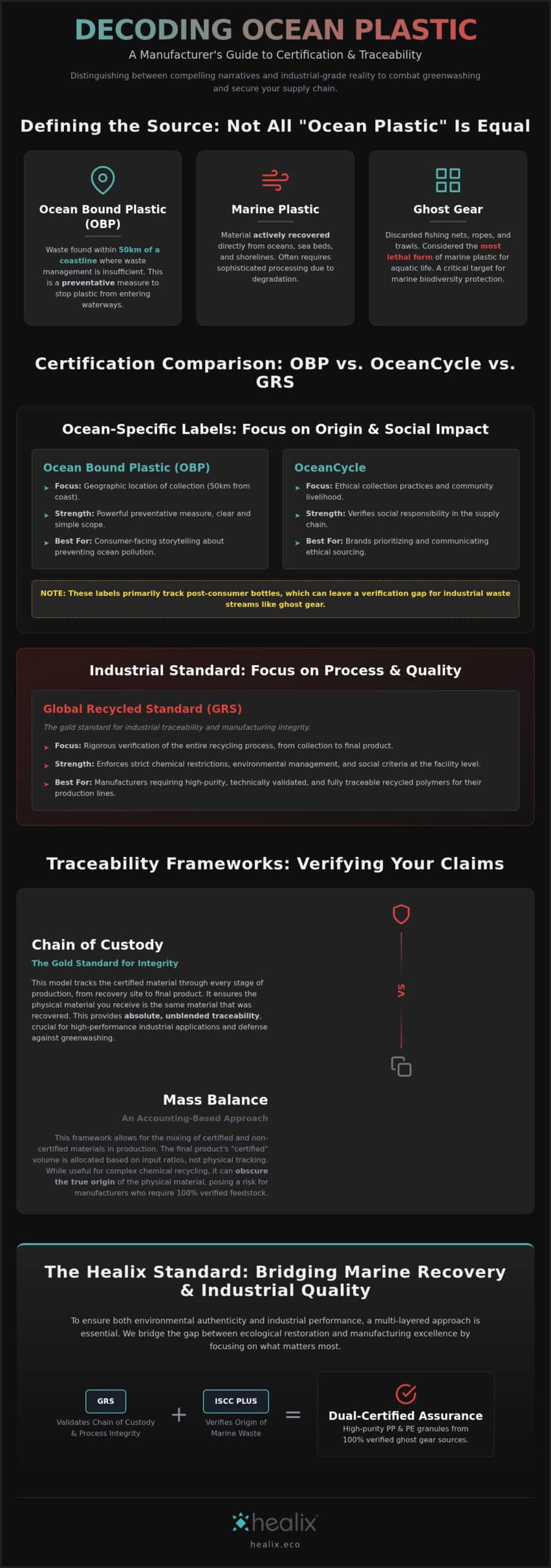
Effective restoration requires a clear understanding of material origins. We define the landscape through three distinct pillars of waste, each presenting different logistical and technical hurdles:
- Ocean Bound Plastic (OBP): This includes plastic waste found within 50km of a coastline where waste management is either non-existent or failing. It’s a preventative category designed to stop pollution before it enters the water.
- Marine Plastic: This is material actively recovered from the ocean, sea beds, or shorelines. It has often begun to degrade and requires sophisticated processing to return to a high-purity state.
- Ghost Gear: These are discarded fishing nets and ropes. It represents the most lethal form of marine plastic for aquatic life. Recovering ghost gear and converting it into certified circular plastic is essential for protecting marine biodiversity.
The Urgency of Standardized Verification in 2026
Regulatory pressure is mounting across the globe as we move through 2026. Governments are shifting beyond suggestions and into the territory of mandatory recycled content targets. This shift makes independent certification a business necessity rather than a voluntary choice. Brands that once relied on self-declared claims now find themselves vulnerable to litigation and public scrutiny. Independent verification protects your brand equity by proving the origin and technical integrity of your materials. It ensures your transition to circular manufacturing is backed by scientific rigor. This movement toward standardized recycled ocean plastic certification comparison isn’t just about compliance; it’s about leading a systemic change that values transparency over convenience. Procurement teams must also account for evolving legislative frameworks, and understanding how to source EU plastic tax compliance materials that meet the 2026 PPWR requirements is now an essential part of any certification strategy.
Comparing the Big Three: OBP, OceanCycle, and GRS
Selection of a material partner requires more than a cursory glance at a logo. It demands a rigorous recycled ocean plastic certification comparison to understand how each framework validates environmental claims. While some labels focus on the geography of collection, others prioritize the technical integrity of the recycling process. For industrial manufacturers, the goal is to find a certification that balances social responsibility with the high-performance requirements of global supply chains. It demands transparency. It requires proof. It demands results.
Ocean-Specific Labels: OBP and OceanCycle
These certifications emphasize the social and geographic context of plastic recovery. The Ocean Bound Plastic (OBP) certification, developed by Zero Plastic Oceans, centers on the risk of mismanagement within 50km of coastlines. Similarly, OceanCycle provides deep verification of ethical collection practices, focusing on the livelihoods of local communities. These labels are powerful tools for consumer-facing storytelling. They prove that the material was diverted from vulnerable ecosystems. However, many of these frameworks primarily track post-consumer bottles. This focus can leave a gap when addressing industrial-scale waste like ghost gear, which requires specialized recovery and processing protocols.
Industrial Standards: GRS and RCS
When your focus shifts to the manufacturing floor, industrial standards like the Global Recycled Standard (GRS) become indispensable. GRS is widely considered the gold standard for industrial traceability. It goes beyond simple collection metrics to enforce strict chemical restrictions and environmental management at the facility level. This framework ensures that the material in your supply chain is not only recycled but also safe and high-quality. This level of oversight is why GRS is essential for certified circular polymers. While the Recycled Claim Standard (RCS) tracks recycled content, it lacks the broader social and environmental requirements that define the GRS model.
True circularity requires a tripartite approach: origin, ethics, and technical purity. While OBP and OceanCycle validate the source, GRS validates the transformation. For companies looking to turn discarded fishing nets into high-performance materials, integrating these standards is the only way to ensure systemic integrity. If you’re ready to explore how these standards apply to high-purity re-granulate, you can view our certified circular plastic specifications to see how we bridge the gap between marine recovery and industrial manufacturing.
Traceability Frameworks: Chain of Custody vs. Mass Balance
Traceability is the backbone of environmental integrity. Without it, a circular claim is merely an unverified promise. In any recycled ocean plastic certification comparison, the method used to track material through the supply chain determines the ultimate value of the resin. We must move beyond simple trust. We must embrace rigorous, data-driven verification. Digital tracking systems and unannounced physical audits are now the standard for 2026, ensuring the physical reality of the material matches the digital record.
The industry relies on two primary models. The first is the Chain of Custody (CoC) model, which includes Identity Preserved and Segregated approaches. These models maintain a physical separation between certified marine waste and other materials. The second is Mass Balance. This is a bookkeeping method where certified and non-certified feedstocks are mixed during production, with the certified volume balanced at the end. While Mass Balance is common in complex chemical recycling, it often lacks the direct, tangible connection to marine recovery that manufacturers demand for their sustainability storytelling. A comprehensive approach to sustainable sourcing of recycled plastic raw materials requires understanding how these traceability models interact with feedstock verification and processing transparency across the entire supply chain.
Why Segregated CoC is Superior for Marine Plastics
For high-impact materials like ghost gear, dilution is the enemy of authenticity. Segregated CoC ensures your PE or PP pellets contain 100% marine-origin material. Mechanical recyclers achieve this by maintaining absolute batch integrity through three distinct phases: isolated collection, dedicated processing lines, and rigorous output testing. This process culminates in the issuance of Transaction Certificates. These documents are the only way to prove a direct link between the discarded fishing nets recovered from the sea and the high-purity re-granulate arriving at your facility.
The Pitfalls of Weak Traceability
Vague documentation remains a primary red flag in the circular economy. If a supplier’s certification lacks a clear, unbroken chain of Transaction Certificates, the risk of “recycled-washing” increases. Fraudulent feedstock, where virgin plastic is intentionally mislabeled as marine-recovered, threatens to dismantle the credibility of the entire industry. This failure of transparency also devastates the accuracy of your Life Cycle Assessment. An LCA is only as reliable as its input data. Without precise traceability, your environmental impact claims become speculative, leaving your brand vulnerable to accusations of greenwashing.
Selection Criteria for Industrial-Grade Circular Polymers
A certification is a baseline requirement; it isn’t a guarantee of mechanical performance. When you conduct a recycled ocean plastic certification comparison, you must look past the environmental claim to the technical data sheet. Industrial manufacturing demands more than just a sustainable story. It requires material that behaves predictably under heat and pressure. Selecting the wrong grade of resin can lead to production downtime, high scrap rates, and compromised product safety. You need a partner that understands the chemistry of circularity as deeply as the ethics of recovery. The global crisis of marine pollution won’t be solved by half-measures. It requires industrial transformation. Manufacturers navigating this transition should also consult a structured EU plastic tax compliance checklist for selecting circular materials to ensure their procurement decisions align with the 2026 PPWR substance restrictions and declaration of conformity requirements.
Technical Specifications and Purity
Marine-recovered plastic faces unique challenges. Constant exposure to UV radiation and saltwater causes significant polymer degradation. Without advanced mechanical purification, these materials can’t meet industrial standards. You must prioritize recycled polypropylene granules that have undergone intensive filtration and decontamination. This process ensures a consistent Melt Flow Index (MFI) across batches. Consistent MFI is critical. It prevents the process fluctuations that plague lower-quality recycled sources. High-purity re-granulate should offer mechanical properties that rival virgin polymers, allowing for a seamless transition to circular manufacturing without retooling your entire facility. We achieve this through a tripartite purification logic: deep washing, fine filtration, and thermal decontamination.
Operational Stability of the Supplier
Traceability is only valuable if the supplier can deliver at scale. When evaluating a circular HDPE supplier, you must assess their long-term volume security and supply chain resilience. A European-based recycling hub offers distinct advantages for global manufacturers, including reduced logistics emissions and closer alignment with EU regulatory frameworks. Transparency is non-negotiable. You should demand a clear audit history of the recycling facility and evidence of consistent performance. A reliable supplier doesn’t just provide a pellet; they provide a stable foundation for your corporate responsibility goals. This stability allows you to meet rising regulatory pressures while maintaining the high-visibility quality your industry demands.
We invite you to request a technical data sheet to see how our certified circular plastic meets the most demanding industrial requirements.
The Healix Standard: Bridging Marine Recovery and Industrial Quality
Healix stands at the intersection of ecological restoration and industrial precision. While a recycled ocean plastic certification comparison highlights various geographic and social standards, we focus on the technical transformation of the most hazardous marine waste: ghost gear. We don’t just participate in the circular economy; we redefine its ethical and technical boundaries. Our mission is to convert discarded industrial fibers into high-purity PE and PP pellets that meet the rigorous demands of global supply chains. We believe that circularity requires a move away from superficial claims toward a future built on scientific rigor and systemic integrity.
Our methodology follows a clear, tripartite logic designed for transparency and results. We Recover abandoned fishing nets and ropes from the marine environment. We Purify these materials using advanced mechanical recycling technology at our Dutch facility. Finally, we Transform the waste into industrial-grade re-granulate. This structured approach ensures that every batch of certified circular plastic provides the missing link between marine recovery and manufacturing excellence. By integrating marine-origin verification with GRS and ISCC PLUS standards, we provide the industrial-grade reliability that modern manufacturing demands.
Focusing on Ghost Gear: The Industrial Advantage
Industrial ghost gear, such as fishing nets and ropes, offers a significant polymer advantage over post-consumer bottles. These materials are typically made from high-density fibers that retain superior mechanical properties even after environmental exposure. By focusing on this specific waste stream, we provide a more robust raw material for demanding applications. Removing these “death traps” from the ocean does more than just supply a factory; it protects marine biodiversity at a systemic level. Our high-quality recycled pellets are already being integrated into diverse sectors, from automotive components to durable consumer goods, proving that ecological health and industrial performance are not mutually exclusive.
Commitment to Systemic Integrity
Transparency is the foundation of our operations. We ensure 100% traceability through advanced mechanical recycling, allowing brands to verify the journey of their materials from the ocean to the production line. We collaborate with global innovators to move beyond the limitations of current waste management systems. We don’t just sell a product; we offer a partnership in systemic change. This commitment to integrity is why we maintain rigorous third-party audits and adhere to the highest international standards. We invite you to explore our certified circular plastic range and join us in redefining the ethical boundaries of the plastic industry.
Securing Your Circular Future
True circularity is no longer a choice; it’s a strategic necessity for the modern manufacturer. This recycled ocean plastic certification comparison has demonstrated that material integrity relies on the intersection of origin, ethics, and technical purity. You now understand that while geographic labels provide a compelling narrative, industrial standards like GRS and ISCC PLUS provide the technical foundation required for high-performance manufacturing. We must move beyond superficial claims. We must embrace verifiable data. We must demand systemic change.
Healix bridges the gap between marine recovery and industrial excellence by transforming high-tenacity industrial fiber waste into high-purity PE and PP pellets. Our Dutch-engineered mechanical recycling technology ensures your supply chain remains resilient and compliant. By choosing GRS and ISCC PLUS compliant processes, you’re not just buying a material; you’re investing in a restorative future. We invite you to Explore Healix’s Certified Circular Polymers and lead your industry toward a truly waste-free world. Your commitment today builds the ecological health of tomorrow.
Frequently Asked Questions
What is the most recognized certification for ocean plastic?
The Global Recycled Standard (GRS) and Ocean Bound Plastic (OBP) certification are currently the most recognized frameworks. While OBP focuses on the geographic risk of mismanagement, GRS provides a comprehensive recycled ocean plastic certification comparison by auditing the entire industrial process. It ensures social responsibility and environmental management at the facility level. Manufacturers often combine these standards to validate both the material’s origin and its technical integrity during mechanical recycling.
Is Ocean Bound Plastic (OBP) the same as recycled ocean plastic?
No, Ocean Bound Plastic (OBP) is a preventative category distinct from material recovered directly from the water. OBP refers to plastic waste located within 50km of a coastline where waste management systems are absent or failing. In contrast, recycled ocean plastic is material actively retrieved from the marine environment or shorelines. Understanding this distinction is vital for accurate environmental claims and ensuring your circular manufacturing strategy targets the correct waste stream.
How does the Global Recycled Standard (GRS) apply to marine waste?
GRS applies to marine waste by providing a robust Chain of Custody (CoC) framework from the collection point to the final pellet. It tracks the percentage of recycled content while enforcing strict chemical restrictions and social labor requirements. This standard is essential for validating the transformation of ghost gear into industrial-grade polymers. It offers the transparency needed to prove that your recycled PE or PP pellets meet global sustainability benchmarks.
Can I use certified ocean plastic for food-contact packaging?
Most certified ocean plastic is currently unsuitable for direct food-contact packaging due to polymer degradation and potential contamination from the marine environment. Mechanical recycling processes for marine waste typically target non-food applications like automotive parts, durable consumer goods, and industrial packaging. For businesses that require food-safe sustainable options, Goodies Distribution provides specialized compostable food packaging solutions as an alternative to recycled marine plastics. You should always verify the specific EFSA or FDA compliance of a resin before considering it for food-grade use, as marine-origin materials face rigorous safety hurdles.
You must request both the Scope Certificate (SC) and the Transaction Certificate (TC) for every batch of material. The Scope Certificate proves the supplier is authorized to process certified materials, while the Transaction Certificate confirms the specific volume you purchased is authentic. Always cross-reference these documents with the official databases of the certifying bodies, such as Textile Exchange for GRS, to ensure the credentials haven’t expired or been falsified.
What are the main challenges in certifying ghost gear recovery?
Certifying ghost gear recovery involves unique logistical challenges, including verifying the exact coordinates of retrieval and managing high-tenacity fiber waste. Unlike consumer bottles, fishing nets are often recovered from international waters or remote ports, making the Chain of Custody more complex. Effective certification requires a tripartite logic of localized collection, dedicated industrial processing, and rigorous third-party auditing to ensure the material isn’t mixed with standard post-consumer waste.
Does certification guarantee the physical quality of the recycled polymer?
Certification doesn’t guarantee physical performance; it only validates the origin and the recycling process. The technical quality of the polymer depends on the supplier’s mechanical recycling technology and purification protocols. While a recycled ocean plastic certification comparison helps you verify ethical claims, you must still evaluate technical data sheets for Melt Flow Index (MFI) and purity. High-purity re-granulate requires intensive filtration to remove the salts and degradants common in marine waste.
How much more expensive is certified ocean plastic compared to standard recycled plastic?
Certified ocean plastic often carries a premium due to the complex logistics of marine recovery and the costs of rigorous third-party auditing. These materials require significant manual labor for collection and specialized mechanical purification to reach industrial standards. While costs vary based on the waste stream and processing depth, the investment reflects the added value of absolute traceability and the positive environmental impact of removing lethal ghost gear from aquatic ecosystems.