A recovered net is only the beginning of its transformation. Ghost net recycling technology turns discarded fishing gear into material for potential reuse through linked stages of collection, preparation and recycling. Nets are gathered, sorted and cleaned to remove attached debris, then processed into feedstock.
Turning a net from ocean waste into useful feedstock depends on more than recycling equipment. Polymer type, condition, contamination and access to processing infrastructure all affect what can be recovered and whether a route is technically and economically feasible. This article explains how collection and preparation work, how mechanical and chemical recycling process nets, and how testing can assess material quality. It also covers the practical factors that shape a viable circular supply chain.
Key Takeaways
- Ghost nets are gathered through different recovery schemes, then sorted and cleaned to separate usable polymer from marine debris.
- Polypropylene recovered from weathered nets can be assessed for recycling by examining its polymer identity, condition and performance after processing.
- Mechanical recycling reshapes prepared plastic into material, while chemical recycling can break certain polymers down into their building blocks.
- Material testing helps determine whether recycled nets meet technical needs; collection logistics and processing infrastructure also influence feasibility.
- Recovered fishing nets can become recycled plastic materials, including PE and PP pellets, when the polymer and recycling pathway are suitable.
Collection Schemes: How Are Fishing Nets Gathered?
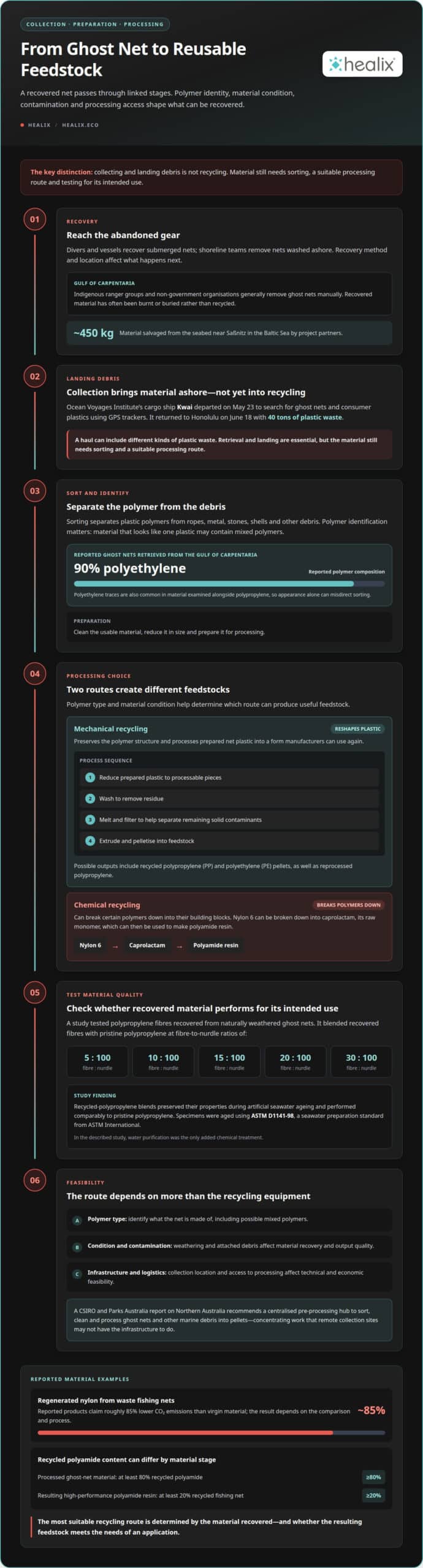
Collection begins where abandoned fishing nets can be reached: divers and vessels recover submerged gear, while shoreline teams remove nets washed ashore. In the Gulf of Carpentaria, Indigenous ranger groups and non-government organisations generally remove ghost nets manually; recovered material has often been burnt or buried rather than recycled. Near Saßnitz in the Baltic Sea, project partners salvaged about 450 kilos of material from the seabed. These examples show why collection method, location and access to processing affect what happens next.
At sea, a recovery operation may gather more than fishing gear. Ocean Voyages Institute’s cargo ship Kwai departed on May 23 to search for ghost nets and consumer plastics using GPS trackers. It returned to Honolulu on June 18 with 40 tons of plastic waste. That haul illustrates the distinction between collection and recycling: locating, retrieving and landing debris are essential, but the recovered material still needs sorting and a suitable processing route.
After collection, nets are sorted to separate plastic polymers from ropes, metal, stones, shells and other debris. The usable material is then cleaned, reduced in size and prepared for further processing. A CSIRO and Parks Australia report on Northern Australia recommends a centralised pre-processing hub to sort, clean and process ghost nets and other marine debris into pellets. Such a hub concentrates work that remote collection sites may not have the infrastructure to do.
In the United States, fishing-net disposal and recycling requirements depend on applicable federal, state and local rules, as well as how and where the gear is handled. Collection plans need to account for location and the material’s route after recovery. Ocean Voyages Institute is an example of a US-based group conducting ocean cleanup and collection. Collecting plastic waste, however, does not by itself establish that ghost nets are recycled.
Polymer identification is vital before processing. Polyethylene traces are common in material examined alongside polypropylene, so a net that appears to be one plastic type may contain mixed polymers. Ghost nets retrieved from the Gulf of Carpentaria were reported as 90% polyethylene, demonstrating that assumptions based on appearance can misdirect sorting. For naturally weathered polypropylene, a described recycling study used water purification as its only added chemical treatment. It tested blends of recovered fibres with pristine polypropylene at fibre-to-nurdle ratios of 5, 10, 15, 20 or 30 to 100. Those controlled blends help assess whether weathered fishing plastic can become usable feedstock, a core question for ghost net recycling technology.
Material and chemical recycling processes
Ghost-net recycling follows two distinct routes: mechanical processing reshapes plastic, while chemical processing breaks polymers down into their building blocks. The polymer type and the material’s condition help determine which route can produce useful feedstock.
Material Recycling Processes
Mechanical recycling preserves the polymer structure, processing prepared net plastic into a form manufacturers can use again. Recovered polypropylene fibres, for example, can be made into blends with polypropylene. Testing the recycled material helps establish whether its performance meets the needs of a particular application.
In mechanical recycling, prepared plastic is reduced to processable pieces, washed, melted, filtered and extruded into pellets. Each stage addresses a different challenge: washing removes residue, while melt filtration helps separate remaining solid contaminants. Pelletising produces a consistent feedstock form, but output quality still depends on polymer identity, contamination and the condition of the discarded net.
One study tested polypropylene fibres recovered from ghost nets after natural weathering. It found that recycled-polypropylene blends preserved their properties during artificial seawater ageing and performed comparably to pristine polypropylene. The specimens were aged using ASTM D1141-98, a seawater preparation standard from ASTM International. This result shows how testing can examine whether a recovered material retains performance under a defined exposure.
Recycled Net Materials
Reprocessed polypropylene and polyamide resin made with recovered fishing-net material are among the possible outputs. The distinction matters: mechanical recycling retains the polymer’s basic identity, while chemical recycling can produce a purified building block for new resin. These routes produce different feedstocks, so the intended application and material requirements guide the choice.
Chemical recycling can break nylon 6 down into caprolactam, its raw monomer. That monomer can then be used to make polyamide resin, returning discarded net material to a chemical building block rather than simply reshaping it. Reported regenerated-nylon products derived from waste fishing nets claim roughly 85% lower CO2 emissions than virgin material, though the result depends on the comparison and process.
Processed ghost-net material has been described as containing at least 80% recycled polyamide, while a resulting high-performance polyamide resin consists of at least 20% recycled fishing net. Those figures illustrate how recycled content can differ between an intermediate material and a finished resin. For applications using polypropylene or polyethylene, recycled PP and PE pellets represent another material route from recovered plastic to industrial feedstock.
Technology and training requirements
Recovering and handling abandoned fishing nets can expose workers to entanglement and attached debris. Salvaged nets may contain anchors, chains, pipes, stones and other materials that need careful separation before processing.
Effective recycling depends on more than machinery. Operators need to identify polymer types, keep material streams separate and run equipment consistently. With ghost nets, that means accounting for how weathering and contamination affect the material, then using testing to guide processing decisions. Training helps connect each technical step with the quality of the resulting feedstock.
Polymer identification is a foundational skill. Raman spectroscopy and Fourier-transform infrared spectroscopy (FTIR) have been used to identify polymers in ghost-net material. These techniques can also help estimate ageing and crystallinity, properties that influence how plastic behaves during processing. Staff need to understand what the measurements indicate and how to keep polymer streams separate.
Keeping materials separate matters, especially in mixed feedstock. After a second water bath, polypropylene and polyamide can be skimmed from the surface and conveyed separately for washing. Operators need to recognise this separation point and maintain distinct streams; mixing polymers can compromise the consistency of material sent for further processing. Training should cover both equipment operation and the purpose of each separation step.
Mechanical recycling also requires coordinated control of preparation and processing. Shredding, washing, feeding, melting and pelletising each place different demands on the material. Operators need to monitor feedstock for debris, adjust handling as the input changes and record observations that help explain output variations. Consistent procedures support repeatable results, but they cannot make mixed or degraded feedstock identical.
Remote collection settings add another challenge. The Gulf of Carpentaria is remote and lacks existing recycling infrastructure, making local capability and practical equipment choices central to any processing pathway. A CSIRO and Parks Australia report recommends a centralised hub to sort, clean and process marine debris. Trained teams can prepare collected material for transport or further processing, helping connect the stages of recovery.
The scale of plastic pollution in the oceans reinforces the need for reliable systems. Technology works only when people can operate it safely, identify materials accurately and maintain separation through each stage. In practice, training links field recovery, material testing and processing into one traceable workflow, helping turn discarded gear into a usable industrial resource.
Testing recycling feasibility and economics
Feasibility depends on whether recovered nets can be turned into reliable feedstock through practical processing. Technical tests and supply-chain analysis show whether collection, preparation and recycling can work together.
Compared with landfill, recycling keeps suitable net plastic in a material-recovery pathway. Incineration destroys the plastic’s material value, even when waste is used for energy recovery. Recycling also requires sorting, cleaning and processing, so contaminated or mixed gear can reduce the amount of usable output.
Economic assessment starts with the material arriving at the facility. Polymer type, contamination, moisture, attached debris and consistency affect the preparation required and the quality of the recyclate. Collection distance and transport matter too: moving abandoned nets from remote coastlines adds logistics to the processing chain. A viable route needs enough suitable material, practical preprocessing and a destination for the recycled output.
Infrastructure is another decisive factor. The Gulf of Carpentaria is remote and lacks existing recycling infrastructure, making local processing capacity central to feasibility. A CSIRO and Parks Australia report recommends a centralised hub to sort, clean and process ghost nets and other marine debris into pellets. This approach concentrates early processing and prepares plastic waste for further recycling or transport.
Environmental benefits can include removing abandoned nets from marine environments and recovering plastic for further material use. Recycling can also reduce reliance on virgin feedstock when recycled output replaces it in production. The result depends on what the collected material can become. Mixed polymers, residues and physical debris require separation, while transport, cleaning and processing consume resources. A sound assessment weighs these inputs against the recovered material’s quality and actual end use, rather than counting collection alone as recycling.
For regional projects, feasibility also involves equipment, training, throughput and access to downstream processors. Parks Australia is supporting trials of marine-debris preprocessing equipment through a $3 million Ghost Nets Innovative Solutions Grant Round. Such trials can test whether sorting and preparation systems work under local conditions, and whether the resulting material can enter an established recycling pathway. Successful recovery depends on linking collection, preprocessing and a practical market for recyclate. If any link is missing, ghost net recycling technology can stall before recovered plastic becomes useful material.
The study concluded that mechanical recycling, including pretreatment and preprocessing, may be suitable for ghost nets and other marine debris in remote or regional communities. This supports assessing mechanical routes alongside the required preparation, while distinguishing potential suitability from proof that a particular project is viable. The key question is whether collected material can be prepared consistently and whether the resulting recyclate has a usable destination. Evaluations should consider processing needs and material quality together, rather than treating collection or preprocessing as evidence of a successful recycling outcome.
Market benchmark data provides a price reference for considering potential output value, not a guarantee of revenue for material recovered from nets. Any economic assessment by Healix or similar operators should account for the feedstock’s polymer type, condition and preparation requirements, as well as the available route for the output. A plausible recycling pathway connects suitable incoming material with processing and an end use; the price figure alone cannot establish that connection.
What materials can ghost nets be recycled into?
Recovered nets can become recycled plastic feedstock, including polypropylene, polyethylene and polyamide materials. The output depends on the polymer in the net and the recycling route. Identifying the polymers first helps direct each fraction to processing that can preserve its value.
Mechanical recycling retains the original polymer family. Prepared polypropylene can be processed into recycled plastic pellets or re-granulate for further manufacturing. Polyethylene nets can follow a similar material-recycling route. These are intermediate materials, not finished consumer products; manufacturers can use them in applications suited to their properties, such as durable containers, industrial goods, or protective custom foam inserts.
Pellets provide a consistent form for handling and feeding into manufacturing processes. Re-granulate is another processed form of recycled plastic. Both depend on effective sorting: mixing different polymers can make the resulting material less consistent. Separating polypropylene from polyethylene therefore matters before processing, not only after the material has been recycled.
Polyamide nets can also enter a different pathway. Nylon 6 can be chemically broken down into caprolactam, its raw monomer, which can serve as a building block for new polyamide resin. This route differs from mechanical recycling because it returns the polymer to a chemical feedstock rather than reshaping it into plastic pieces or pellets. The distinction helps explain why different net polymers need different processing approaches.
Material condition shapes the usefulness of each output. Nets may be weathered, contaminated or mixed with debris, so preparation and polymer separation affect the quality of recovered feedstock. Testing helps establish whether processed plastic retains properties suited to its intended manufacturing use. A recycled pellet is a starting material, not proof that it suits every application.
There is no single destination for every recovered net. Separated polypropylene can become recycled PP feedstock, while polyethylene can become recycled PE material. Suitable polyamide may provide input for resin production. The route depends on polymer identity, cleanliness, processing capability and the requirements of the next manufacturing step. Traceability matters from the original net through to the recycled resin or pellet. Meanwhile, businesses operating in specialized sectors like food production that require dedicated netting, twine, and packaging materials can source compliant solutions through scotnet.com.
For industrial supply chains evaluating recycled plastic inputs, explore circular material pathways to understand how recovered polymers can re-enter production.
The material recovered with a net can also affect how it is prepared for recycling. The salvaged ghost nets contained 14 kilos of scrap metal, including anchors, chains and pipes. They also contained 37 kilos of stones and boulders, 21 kilos of mussels, and 4 kilos of textiles and shoes. These materials are distinct from the net polymers, so separating them helps keep debris from entering plastic feedstock and makes the composition of each processed fraction clearer.
The scale of the problem also puts recovery in context: ghost nets make up at least 46% of the Great Pacific Garbage Patch. Ocean Voyages Institute reported finding more nets in areas where it found one net. That pattern suggests recovered material may be accompanied by further net debris, rather than arriving as an isolated, clean stream. Careful sorting and recording what is removed alongside the nets can therefore support more reliable processing and make it easier to assess the quality and suitability of the resulting feedstock.
Healix
Healix turns recovered fishing and farming plastics into circular material inputs for industrial supply chains. For manufacturers assessing recycled feedstock, the next step is to match material requirements with suitable recycled polymers and formats. Healix supplies certified circular plastic, recycled PP and PE, and high-quality recycled pellets.
Collection and recycling pathways meet industrial demand when recovered plastic becomes a usable, consistent production input. Contact Healix to discuss recycled material options for your supply chain.
Turn recovered material into a circular supply chain
The next step is to connect recovered plastic with a clear industrial purpose. Aligning material requirements, processing capabilities and supply-chain demand helps turn recovered polymers into useful production inputs. Ghost net recycling technology can support this shift, but lasting progress depends on collaboration across recovery, recycling and manufacturing.
For organisations developing products or sourcing recycled feedstock, Healix offers certified circular plastic, recycled PP and recycled PE. These materials can bring circular inputs into industrial supply chains and support demand for recycled resources.
Start a conversation about how recycled materials could fit your supply needs. Contact Healix about net recycling and take a practical step toward keeping plastic in circulation.
Frequently Asked Questions
What technologies are used to recycle ghost fishing nets?
Ghost-net recycling uses mechanical processing for suitable plastics and chemical recycling for polymers that can be broken into building blocks. Material identification can involve Raman spectroscopy or FTIR, which help distinguish polymers and assess characteristics such as ageing and crystallinity. The choice of process follows the net’s composition and condition. For example, nylon 6 can be chemically converted into caprolactam, while polypropylene can be reprocessed as plastic feedstock.
How are recovered fishing nets sorted, cleaned, and processed for recycling?
Recovered nets are separated by polymer and cleared of attached debris before recycling. Sorting distinguishes plastic from metal, stones, shells and textiles, then separates polymers such as polypropylene and polyamide. Washing removes residue; after a second water bath, polypropylene and polyamide can be skimmed separately for further washing. Shredding and pelletising prepare clean plastic for processing, while mixed or contaminated fractions need additional separation.
How much does ghost net recycling cost per ton?
There is no single per-ton rate for ghost-net recycling; the price depends on the case and is provided after a quote request. Key cost factors include the net’s polymer mix and contamination, the work needed to sort and clean it, the available volume and transport from the recovery point to processing. Remote collection can add logistics. Costs also depend on the processing route and the specifications required for the resulting material.
How can fishing crews report, retrieve, and recycle ghost nets?
Crews can report a net’s location and visible condition to a relevant local marine-debris program, port authority or organised cleanup group. Share whether it is floating, submerged or entangled, and note any visible attached gear. Recovery should be coordinated with a team equipped for the conditions rather than treated as routine deck work. After retrieval, sorting by polymer and contamination helps identify a suitable recycling route; not every processor handles recovered marine gear.