Tax compliance is no longer a task for your accounting department; it’s a strategic mandate for your procurement team. As the August 12, 2026, application date for the Packaging and Packaging Waste Regulation (PPWR) approaches, the cost of inaction is becoming a line item that no balance sheet can ignore. You likely feel the pressure of managing fragmented member state levies and the looming €0.80 per kilogram EU contribution on non-recycled waste. Finding high-quality EU plastic tax compliance materials that don’t sacrifice industrial performance is the new competitive frontier.
We understand that transitioning from virgin polymers to circular alternatives feels like a gamble with your product integrity. This guide provides a clear material procurement checklist to ensure your supply chain meets the 2026 substance restrictions and declaration of conformity requirements. We will examine how to secure certified recycled PP and PE, verify supply chain traceability, and implement a three-phase transition strategy that protects your margins while restoring the planet.
Key Takeaways
- Understand the fiscal implications of the €0.80 per kilogram levy and how the transition to the PPWR shifts compliance from a national directive to a mandatory industrial regulation.
- Identify high-performance EU plastic tax compliance materials by applying a tripartite logic that prioritizes material origin, polymer purity, and rigorous third-party certification.
- Learn why achieving the 30% recycled content benchmark serves as a critical financial shield against escalating non-recyclability penalties across EU member states.
- Transition from volatile spot buying to strategic partnership sourcing to guarantee the volume of certified circular polymers required for your 2026 production cycles.
- Discover how integrating traceable re-granulate derived from industrial waste, such as fishing nets, allows you to maintain industrial quality while eliminating virgin plastic tax liabilities.
Navigating the 2026 EU Plastic Tax and PPWR Landscape
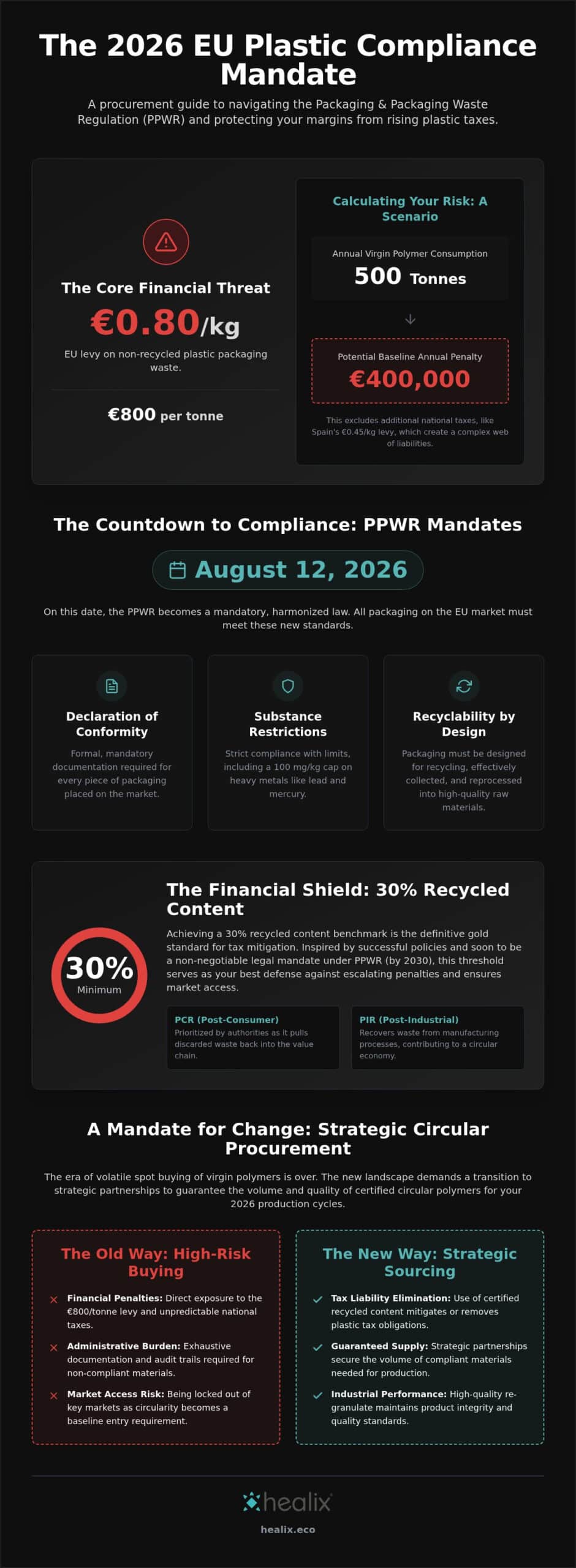
The industrial landscape is undergoing a tectonic shift. For decades, packaging waste was an afterthought of the procurement cycle. That era ended with the introduction of the EU plastic levy. This fiscal measure imposes a €0.80 per kilogram charge on non-recycled plastic packaging waste. While technically a contribution from member states to the EU budget, the financial burden is rapidly trickling down to manufacturers. Governments are recouping these costs by introducing aggressive national taxes, such as Spain’s €0.45 per kilogram levy on non-reusable plastic. Italy and other member states are following suit, creating a complex web of financial liabilities.
The transition from the Packaging and Packaging Waste Directive to the Packaging and Packaging Waste Regulation (PPWR) 2025/40 marks the end of fragmented national rules. This is no longer a set of guidelines; it’s a direct, harmonized law that applies across all member states. By August 12, 2026, the industry reaches a point of no return. Procurement teams must secure EU plastic tax compliance materials now or face systemic financial penalties that could erode entire profit margins. Waiting for the 2030 targets is a strategic failure. The market is already pricing in the cost of virgin polymers, and the supply of high-quality recycled content is tightening.
The Cost of Inaction: Calculating Potential Tax Liabilities
The math is simple but brutal. A penalty of €800 per tonne of virgin plastic can turn a profitable product line into a liability overnight. High-volume industrial supply chains are particularly vulnerable. If you consume 500 tonnes of non-compliant polymer annually, you’re looking at a €400,000 baseline penalty before national taxes are even applied. Beyond the direct levy, businesses face a “hidden tax” in administrative complexity. Reporting non-compliant materials requires exhaustive documentation and audit trails. Transitioning to high-quality re-granulate isn’t just about environmental stewardship. It’s about eliminating the overhead of proving why your packaging failed to meet circular standards.
PPWR 2025/40: Key Deadlines for Manufacturers
The countdown to August 12, 2026, is the most critical window for industrial strategy. On this date, the PPWR mandates that every piece of packaging placed on the EU market must have a formal Declaration of Conformity. Manufacturers must also prove compliance with strict substance restrictions, including a 100 mg/kg limit on heavy metals like lead and mercury. While the 30% recycled content mandate for most packaging doesn’t take effect until 2030, the infrastructure for EU plastic tax compliance materials must be built today. According to the latest EU criteria, packaging is considered recyclable only when it is designed for recycling, can be effectively collected, and is reprocessed into high-quality secondary raw materials that replace virgin plastics.
The 30% Benchmark: Why Recycled Content is Your Best Defense
The 30% recycled content threshold has emerged as the definitive gold standard for tax mitigation. Inspired by the success of the UK’s Plastic Packaging Tax, several EU member states are adopting this benchmark to define what constitutes a truly circular product. Under the EU Packaging and Packaging Waste Regulation (PPWR), mandatory targets will soon transform this voluntary shield into a non-negotiable legal mandate. For manufacturers, securing high-performance EU plastic tax compliance materials is no longer an elective sustainability goal. It’s a core survival strategy. Accessing the right EU plastic tax compliance materials ensures that your products remain competitive in a market that increasingly penalizes virgin plastic dependency.
The distinction between post-consumer recycled (PCR) and post-industrial recycled (PIR) content is vital for accurate tax reporting. Authorities increasingly prioritize PCR, as it directly addresses the ecological crisis by pulling discarded waste back into the value chain. As global supply chains tighten their entry requirements, “certified circular plastic” is moving from a premium option to a baseline necessity. Brands that fail to integrate these materials will find themselves locked out of key markets or buried under escalating levies.
Virgin vs. Recycled Polymers: A Financial Comparison
Calculating the total cost of ownership (TCO) requires a shift in perspective. Virgin resins might seem affordable on a spot-buy basis, but once you factor in the €800 per tonne EU levy and national eco-modulation fees, the economic reality changes. High-quality certified circular polymers serve as a financial buffer against this volatility. By integrating recycled PP or PE, you actively lower your exposure to Extended Producer Responsibility (EPR) fee escalations. These fees are now eco-modulated. Non-recyclable designs face punitive financial penalties, while circular materials benefit from significant fee reductions. This creates a predictable cost structure that protects your long-term margins.
Beyond Packaging: Industrial Applications and Tax Scope
The scope of the plastic levy often surprises procurement teams. It reaches far beyond primary consumer containers. It covers industrial essentials like transport pallets, heavy-duty crates, and protective stretch wraps. If these assets fall below the recycled content threshold, they trigger a tax liability based on their total plastic weight. Transitioning to mono-material designs using high-purity re-granulate simplifies the compliance process. It removes the administrative burden of calculating tax for multi-material components. Securing a consistent stream of certified circular plastic ensures your industrial operations remain lean and tax-efficient. This strategic move preserves your capital while demonstrating a commitment to systemic environmental restoration.
The EU Plastic Tax Compliance Materials Checklist
Selecting EU plastic tax compliance materials requires more than a simple data check; it demands a physical audit of the polymer’s lifecycle. To bridge the gap between regulatory intent and industrial reality, we employ a tripartite logic: Origin, Purity, and Certification. This framework ensures that every tonne of resin entering your facility serves as a verifiable tax shield. The window for experimentation is closing. By August 12, 2026, the lack of a material-first procurement strategy will translate directly into fiscal liability.
Use this definitive checklist to evaluate your current and future polymer sources:
- Third-Party Certification: Verify that materials carry recognized credentials such as GRS, ISCC PLUS, or UL. These aren’t just badges; they’re your legal defense during a tax audit.
- Chain of Custody Documentation: Secure full traceability from the collection point of the raw waste to the final pellet production. If the trail is cold, the tax exemption is void.
- Technical Data Sheet (TDS) Alignment: Ensure the recycled content matches the mechanical specifications of your original virgin resins to avoid costly production downtime.
- Consistency of Supply: Confirm the supplier’s capacity to deliver stable volumes over multi-year cycles. Fragmented sourcing leads to inconsistent tax reporting and operational risk.
Verifying Certification and Traceability
Auditing a supplier’s claims is the only way to prevent greenwashing tax fraud. Authorities are increasingly sophisticated in their detection of fraudulent recycled content claims. Utilizing a recycled ocean plastic certification comparison guide allows your team to distinguish between robust, traceable sources and unverified marketing claims. This level of scrutiny is essential for meeting the documentation standards required by EU customs for imported resins. These efforts align with the broader Circular Economy Action Plan, which seeks to standardize how materials are tracked and valued across the continent. Don’t just accept a certificate; verify the audit trail behind it. Understanding the full scope of recycled plastic supply chain transparency is essential to distinguishing legitimate circular materials from unverified claims that could expose your business to legal liability.
Technical Integrity: Ensuring Performance at Scale
Circular polymers must perform under pressure. When sourcing recycled PE or PP, focus on the melt flow index (MFI) and tensile strength. Mechanical recycling, when executed with precision, preserves the polymer chain length necessary for high-performance industrial applications. This prevents the brittleness often associated with lower-quality re-granulate. Industrial-grade circularity refers to recycled polymers that maintain the molecular integrity and mechanical properties required to replace virgin resins without necessitating equipment recalibration or compromising product safety. Procuring EU plastic tax compliance materials is a strategic commitment to systemic integrity. It’s about ensuring that your transition to circularity is technically seamless and fiscally sound.
Mitigating Risk through Strategic Circular Procurement
To further strengthen your organization’s approach to these systemic shifts across your entire value chain, you can discover Symolem, an advisory firm that provides expert guidance on sustainability policy and circularity.
Eliminating tax liability is no longer a reporting function; it’s a proactive procurement strategy. While many organizations rely on reactive monitoring of legislation, the impending 2026 deadline demands a systemic shift in how you acquire raw materials. You must transition from transactional spot buying to long-term partnership sourcing. This strategic move ensures your access to verified EU plastic tax compliance materials as global demand intensifies and supply chains tighten. Integrating material compliance into the early stages of product R&D allows your team to design out fiscal risk before a single unit is manufactured.
A primary example of high-integrity feedstock is ghost gear. Discarded fishing nets and ropes provide a stable, industrial-grade stream for recycled polypropylene granules. This isn’t merely waste management. It’s a technical solution that delivers high purity and mechanical consistency. By replacing virgin resins with these circular polymers, you simultaneously neutralize tax liabilities and significantly reduce your Scope 3 emissions. In this context, tax compliance acts as a catalyst for deeper environmental restoration and supply chain integrity.
Future-Proofing Your Supply Chain
The PPWR roadmap doesn’t end in 2026. The escalations scheduled for 2030 and 2040 will require even higher inclusion rates of recycled content across all packaging categories. Selecting a circular HDPE supplier is therefore a decision that impacts your long-term operational resilience. You need a partner who understands the technical nuances of mechanical recycling and can provide a stable inventory of certified circular plastic. True resilience is built through three distinct phases: volume security, quality verification, and technical partnership. For a comprehensive framework on how to execute each of these phases with precision, the sustainable sourcing of recycled plastic raw materials guide for 2026 provides the operational depth required to build a fully accountable supply chain.
The Role of Transparency in Tax Audits
Preparation is your best defense against the burden of proof required by tax authorities. The EU is moving toward mandatory Digital Product Passports (DPP), which will require granular data on material origin and recycling history. Transparent sourcing simplifies the inspection process, turning a potential audit into a routine verification of your EU plastic tax compliance materials. Manufacturers who invest in recycled plastic supply chain transparency are better positioned to satisfy these granular data requirements and convert regulatory scrutiny into a competitive advantage. By conducting rigorous supplier audits now, you build brand equity and demonstrate a principled commitment to systemic change. This transparency transforms a regulatory hurdle into a competitive advantage that resonates with global stakeholders. Secure your 2026 compliance strategy by sourcing certified circular plastic that meets the highest standards of industrial purity.
Securing Compliance with Healix Certified Circular Polymers
Strategic procurement requires a partner capable of turning environmental liabilities into industrial assets. Healix operates at the intersection of ecological restoration and regulatory necessity. We transform discarded fishing nets and ropes into high-quality EU plastic tax compliance materials. This process targets the most persistent forms of marine plastic, re-engineering them into certified circular plastic that meets the rigorous demands of modern manufacturing. By choosing our re-granulate, you aren’t just avoiding a levy; you’re actively participating in the restoration of marine ecosystems while securing your supply chain against future fiscal shocks.
The technical advantage of our recycled PP and PE pellets lies in our precision mechanical recycling process. We prioritize the molecular integrity of the polymer, ensuring that our re-granulate can seamlessly replace virgin resins in existing production lines. This high level of purity is essential for generating the “Chain of Custody” documentation required for EU tax exemptions. We provide the transparent audit trail that tax authorities demand, moving your compliance strategy from a point of friction to a point of operational excellence.
High-Quality Pellets for Demanding Industries
Industrial performance should never be the cost of circularity. Our high quality recycled pellets are currently utilized in high-stakes applications, including automotive components, durable suitcases, and precision-engineered sunglasses. Mechanical recycling at Healix is specifically designed to preserve the polymer chain length, maintaining the structural integrity required for reusable packaging systems and long-life industrial goods. This technical consistency allows you to meet the 2026 substance restrictions without compromising on product safety or durability. Partnering with Healix for 2026 compliance ensures your transition to a circular model is both technically sound and fiscally optimized.
A Professional Leader in the Circular Movement
As a Dutch visionary guide in the global plastic crisis, Healix combines scientific rigor with a philosophical commitment to future generations. We don’t just supply raw materials; we redefine the ethical boundaries of the plastic industry. Our methodology is rooted in transparency, order, and systemic integrity, moving beyond the failures of current industrial models toward a future of true circular successes. We invite you to join this mission-driven movement. Contact Healix to secure your certified circular plastic supply and ensure your organization is ready for the challenges of 2026 and beyond.
Building a Resilient Circular Future
The transition to a circular economy is no longer a peripheral sustainability goal; it’s a fundamental requirement for industrial survival. By August 12, 2026, the ability to secure high-integrity EU plastic tax compliance materials will define the financial health of your manufacturing operations. Success requires a rigorous approach to material origin, technical purity, and third-party certification. Moving from virgin polymers to circular alternatives isn’t just a tax mitigation strategy. It’s a strategic mandate to rebuild your supply chain on a foundation of transparency and ecological restoration. Manufacturers seeking to operationalize this mandate will find that a structured approach to the sustainable sourcing of recycled plastic raw materials is the most effective way to achieve both regulatory compliance and supply chain resilience.
Healix stands ready to facilitate this systemic change through three core pillars: ISCC PLUS and GRS certified materials, high-purity mechanical recycling for industrial-grade PE/PP, and full traceability from ghost nets to certified pellets. We bridge the gap between regulatory mandates and industrial performance. Don’t let the 2026 deadline become a fiscal liability. Secure your supply of certified circular polymers for 2026 compliance and join us in redefining the future of plastic. Together, we can restore the planet’s health while ensuring your business remains competitive, compliant, and principled.
Frequently Asked Questions
What is the specific EU plastic tax rate for 2026?
The EU plastic levy is set at a rate of €0.80 per kilogram of non-recycled plastic packaging waste. This contribution is calculated based on the weight of plastic packaging that is not reprocessed into new materials. While it’s a fiscal obligation for member states, many have implemented national taxes, like Spain’s €0.45 per kilogram charge, to incentivize the use of high-quality recycled pellets and ensure industrial compliance.
How do I prove that my plastic packaging contains 30% recycled content?
Proving 30% recycled content requires a robust audit trail that includes third-party certifications and a formal Declaration of Conformity. You must utilize EU plastic tax compliance materials that are verified through standards such as GRS or ISCC PLUS. These documents track the material from the waste collection point to the final re-granulate, providing the scientific rigor necessary to satisfy tax authorities and avoid heavy financial penalties during audits.
Does the EU plastic tax apply to imported goods?
Yes, the EU plastic levy and associated national taxes apply to all packaging placed on the EU market, including imported goods. Importers are responsible for ensuring that their packaging meets the same recyclability and recycled content standards as domestic products. Failure to provide proof of compliance for imported resins or finished packaging will result in the application of the full tax rate based on the total weight of the plastic used.
What is the difference between the EU plastic levy and the PPWR?
The EU plastic levy is a fiscal contribution from member states to the EU budget based on waste weight, while the PPWR 2025/40 is the overarching regulation. The levy provides the financial pressure to move away from virgin resins, whereas the PPWR establishes the legal framework for design, substance restrictions, and mandatory recycled content targets. Together, they create a systemic shift toward circularity by aligning economic incentives with environmental mandates.
Can post-industrial recycled (PIR) plastic be used to avoid the tax?
Post-industrial recycled (PIR) plastic can often be used to reduce tax liability, though regulations increasingly prioritize post-consumer recycled (PCR) content. Under national laws like the Spanish plastic tax, both PIR and PCR are eligible for exemptions if they’re certified by an accredited body. However, as the EU plastic tax compliance materials landscape evolves, manufacturers should focus on high-purity mechanical recycling to ensure their feedstock meets the strictest future definitions of circularity.
What certifications are recognized by EU tax authorities for recycled plastics?
EU tax authorities and customs officials primarily recognize certifications that provide a transparent chain of custody, such as ISCC PLUS, GRS, and EUCertPlast. These certifications verify that the recycled content is legitimate and not a result of greenwashing. Relying on unverified supplier claims is a significant risk; only materials backed by these rigorous, third-party audits can serve as a valid tax shield for your industrial packaging and components.
How does the PPWR 2025/40 affect non-packaging industrial plastics?
While the PPWR 2025/40 primarily targets packaging, its scope includes industrial items often overlooked, such as transport pallets, crates, and stretch wraps. If these items are used to protect or handle goods within the supply chain, they must comply with the new recyclability and reporting requirements. This shift forces a total re-evaluation of industrial procurement; for those seeking specialized industrial components, you can visit PVC Slangen Expert to find a variety of solutions as the industry moves away from single-use virgin plastics toward durable, high-performance certified circular plastic.
If a supplier cannot provide comprehensive traceability documentation, your material will be legally classified as 100% virgin plastic. This classification triggers the maximum tax liability and may prevent you from issuing a valid Declaration of Conformity required by the PPWR. To mitigate this risk, you must transition to strategic partnerships with suppliers who provide full transparency from the initial waste source, such as discarded fishing nets, to the final re-granulate.