A circular packaging ambition is only as credible as the material behind it. More than 90 billion tonnes of raw materials are extracted from the Earth’s spheres each year, making responsible sourcing and effective reuse central challenges for manufacturers. Choosing sustainable manufacturing raw materials means looking beyond recycled content alone: origin, material quality, contamination control and dependable supply all shape whether a material can support consistent production.
For plastic manufacturers considering the EU Packaging and Packaging Waste Regulation (PPWR), material decisions have practical consequences for packaging design and sourcing. Compliance matters, but so does the supply chain: inconsistent recycled inputs can complicate production, while reliable sourcing can help manufacturers use circular materials with greater confidence. This article explains what sustainable manufacturing involves, how to assess responsible sourcing and recycled-material quality, and what to look for in a supplier. The aim is to turn environmental goals into sound material decisions.
Key Takeaways
- Assess materials by their origin, resource impacts, and potential for reuse, not recycled content alone.
- Map supply chains beyond direct suppliers to improve visibility into sourcing risks and possible disruptions.
- Manage recycled-material variation by considering resin type, grade, and contamination alongside production needs.
- Look for suppliers that can support dependable sourcing and consistent material quality.
- Compare environmental impact across extraction, manufacturing, and end of life to identify better-fitting materials.
What Is Sustainable Manufacturing?
Sustainable manufacturing connects material selection, production, and end-of-life planning. It aims to meet production needs while reducing environmental harm and preserving resources. The scale is substantial: more than 90 billion tonnes of raw materials are extracted from the Earth’s spheres each year. For manufacturers, the challenge is not simply using less. It is designing supply chains that make materials traceable, productive, and recoverable.
Raw-material shortages and price volatility can disrupt production. A shortage of one input may slow operations, while a sudden price change can make a product less economical to manufacture. These pressures can increase when supply relies on a narrow group of sources, long transport routes, or materials with few alternatives. Sustainable manufacturing raw materials therefore means considering availability and environmental impact together, rather than treating procurement as a last-minute purchasing task.
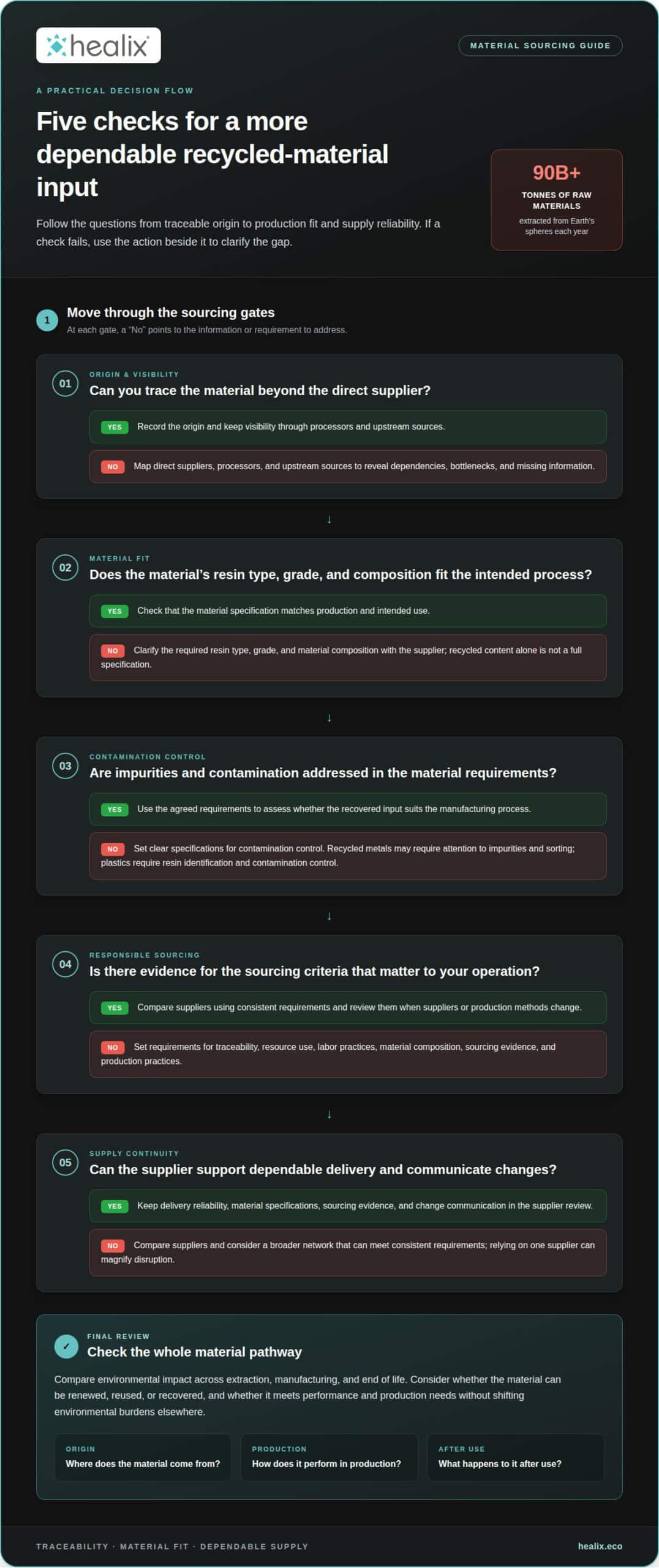
A resilient supply chain starts with visibility. Map direct suppliers, then trace important materials through processors and upstream sources. This helps reveal where disruption could affect production and where information is missing. For example, a packaging manufacturer can trace resin from its source through processing and conversion. The resulting map gives procurement and production teams a shared view of dependencies, potential bottlenecks, and opportunities to qualify alternative inputs.
Supplier networks also need active management. Compare suppliers on material specifications, sourcing evidence, delivery reliability, and communication about changes. Relying on one supplier may simplify purchasing, but it can magnify disruption. A broader network can improve resilience when suppliers meet consistent requirements. Sustainable supply-chain management links these decisions to environmental and social considerations, then revisits them as materials, production needs, and risks change.
Mineral supply chains show why a wider view matters. A material may pass through several extraction, refining, and manufacturing stages before reaching a component supplier. Each stage can affect resource use, environmental impacts, and supply continuity. In renewable energy equipment, for instance, minerals used in batteries or electrical components connect extraction choices to downstream manufacturing. Mapping those stages helps businesses identify dependencies and assess sourcing across the value chain.
Value-chain optimization turns that information into coordinated action. Production teams can reduce scrap through process control, while design teams can specify materials that suit manufacturing and recovery needs. Procurement can align supplier requirements with those specifications. These functions need to work together: a material change that reduces waste must still meet product performance and production requirements. Reviewing sourcing, manufacturing, and end-of-life pathways as one system can reveal trade-offs that isolated purchasing decisions miss.
Start with three connected questions: where does each material come from, how does it perform in production, and what happens after use? Use supply-chain mapping to identify exposure, supplier management to strengthen continuity, and value-chain reviews to improve material efficiency. These steps give manufacturers a practical basis for responsible development. They also help distinguish a sustainable sourcing strategy from a material substitution that shifts environmental burdens elsewhere.
Responsible raw-material sourcing and supplier requirements
Responsible sourcing connects environmental and social criteria with material performance and supply continuity. For U.S. sourcing, manufacturers can map direct suppliers and upstream processors, then set requirements for origin, grade, contamination, and production practices.
Responsible Sourcing Requirements
Responsible raw-material sourcing means selecting inputs with attention to their environmental, social, and economic impacts across production. A material’s origin and processing can affect ecosystems, workers, and supply reliability. Set supplier requirements for traceability, resource use, labor practices, and material composition. Apply consistent criteria to purchasing decisions, and review them when suppliers or production methods change.
Resource-Efficient Material Sourcing
Sustainable sourcing favors materials that can be renewed, reused, or recovered while limiting resource depletion and waste. Resource efficiency also means matching each input to its intended use, avoiding unnecessary consumption, and reducing production scrap. For example, a manufacturer can assess whether a component needs virgin material throughout or whether recycled content can meet its performance requirements. The right choice can support supply resilience and environmental goals together.
Recycled Material Supply
Recycled sourcing depends on matching recovered material to each manufacturing process. Battery recycling can return materials to supply chains, while recycled metals require attention to impurities and sorting—an area where specialized suppliers such as carbidekings.com provide recoverable industrial tungsten and carbide scrap. Paper sourcing must distinguish grades such as newspaper and cardboard, which need different processing. Plastic sourcing likewise requires resin identification and contamination control. Clear specifications help suppliers provide inputs that fit production, rather than simply meeting a broad recycled-content description.
Material Grades and Regulations
A material grade describes characteristics relevant to processing and intended use, while sourcing regulations vary by material, market, and application. A recycled input may offer environmental benefits but still be unsuitable if its grade or composition conflicts with product requirements. Manufacturers can define acceptance criteria for resin type, contamination, and performance, then align purchasing documentation with the rules that apply to their products and markets.
For U.S. suppliers, translate those criteria into a consistent sourcing process: map the supply chain, document material specifications, and assess environmental and labor practices. Include upstream processors where possible, because visibility can diminish beyond direct suppliers. Check incoming materials against agreed grades and contamination limits, then communicate specification changes across procurement and production. These steps make supplier requirements practical, not merely aspirational.
For plastic manufacturing, recycled plastic materials can support sourcing strategies that prioritize recovered inputs and defined material requirements.
Quality variation and contamination in recycled materials
Recycled inputs can vary in resin type, grade, color, and contamination, affecting processing and finished-product quality. A plastic manufacturer may receive material with residues or mixed polymers that behave differently during extrusion. Sorting and controlled processing help manage these differences, but specifications must fit the intended application. Check incoming materials against production requirements for resin identity, contamination, and performance before changing a material mix.
Recycled, renewable, and virgin materials have no universal cost or performance ranking. Costs and results depend on grade, availability, processing needs, and the product specification. Virgin resin may offer familiar processing characteristics, while recycled inputs can vary by source and preparation; renewable materials also differ by composition and application. Compare samples under the same production conditions, including processing behavior and finished-product performance.
Trade-offs can include variable quality, contamination, supply constraints, and production adjustments. Sustainable material choices can also shift environmental impacts among extraction, processing, transport, and end of life. For example, a lighter package may use less material but still needs assessment for durability and recovery routes. Evaluate the complete application, rather than relying on a single label or attribute, before adopting a substitute.
Waste prevention comes first in a circular material cycle: use only the material needed, then preserve recoverable material through reuse or recycling. Recycling can return suitable waste to production, but sorting and contamination control determine whether materials remain usable. International supply chains add complexity when collection, processing, and manufacturing happen in different places. Trace the material’s route and identify where quality can change before relying on recycled content at scale.
Solar panel manufacturing illustrates the link between material quality and end-of-life planning. Panels contain multiple materials assembled into one product, so recycling requires separation and suitable processing technologies. Manufacturers assessing solar components can consider material composition during design, then examine how components may be recovered after use. This connects manufacturing choices to future resource recovery, rather than treating recycling as a separate downstream concern.
Recycled and biobased label materials also need application-specific assessment. A label combines a face material, adhesive, and package, each of which can affect manufacturing and end-of-life handling. Assess whether the label remains compatible with the package’s intended sorting and recycling pathway. Biobased origin alone does not establish how a label performs or behaves at disposal, so compare the complete label construction.
Use a controlled evaluation: define material specifications, test representative batches in production, and record quality results. Separate resin types and grades where needed, and track contamination as a distinct issue instead of treating all recycled feedstock alike. This approach helps balance product quality with material costs while connecting waste prevention, recycling, and carbon considerations. It also gives teams a clearer basis for selecting technologies and improving circular material flows.
Finding reliable recycled-material suppliers
Reliable recycled-material supply depends on more than a sustainability claim. Manufacturers need inputs that meet production specifications and come with clear information about origin and processing. Collecting recycled materials independently can involve costs, risks, and complexity, so a capable supply partner can help manage sourcing and material preparation. The right relationship connects feedstock, processing, and manufacturing requirements instead of treating each purchase as an isolated transaction.
Start by defining production requirements. Specify resin type, grade, acceptable contamination, and the performance needed in the finished application. For example, a manufacturer using recycled PE should define the required material characteristics rather than make a general request for recycled plastic. Clear specifications help suppliers identify suitable feedstock and processing routes, while giving receiving and production teams shared criteria for assessing each delivery.
Then assess how the supplier manages material consistency. Request information about feedstock origins, sorting, contamination controls, and the steps used to produce the material. A supplier that can explain these stages gives manufacturers a clearer view of potential variation. That visibility matters when changes in incoming material could affect processing conditions, product quality, or production planning.
- Traceability: Establish what origin and processing information accompanies each material type.
- Quality controls: Align incoming checks with resin, grade, and contamination requirements.
- Communication: Agree how changes in feedstock or material characteristics are reported.
Use production trials to assess suitability before relying on a recycled input across a product range. Compare processing behavior and finished-product results with the existing specification. Record findings by material type, then use them to guide purchasing and production decisions. This turns supplier discussions into practical evidence and helps teams identify which materials fit which applications.
Supplier reliability also depends on continuity. Consider how the supplier communicates about available feedstock, processing changes, and possible interruptions. A global supply chain can involve several collection and processing stages, so clear information helps manufacturers understand where changes may arise. Make communication part of routine purchasing reviews rather than waiting until a delivery differs from expectations.
Include environmental assessment in the same conversation. Ask how sourcing and processing affect resource use, waste, and emissions, and consider transport as part of the wider supply chain. No single claim describes the full impact. Comparing the material pathway with the manufacturing application can reveal trade-offs and support circular production without overlooking product requirements.
Finally, treat the supplier relationship as an ongoing partnership. Share specification changes, review quality results, and use production feedback to refine material requirements. This structured exchange can help both sides address variation early and identify appropriate process adjustments. A dependable recycled-material supply is built on clear expectations, traceable information, and consistent evaluation, not a label alone.
Which raw materials have the lowest environmental impact?
No single raw material has the lowest environmental impact in every application. Compare its extraction or production, manufacturing life cycle, and end-of-life pathway. For example, timber can be sustainable when sourced from forests managed for regrowth and healthy ecosystems. Its suitability still depends on product performance needs and the impacts of processing, transport, and disposal.
Start with the function the material must perform. A packaging component needs to protect its contents and fit existing manufacturing processes, not merely carry an environmentally preferable label. Then assess the complete material pathway, including land use, water and energy consumption, potentially harmful chemistry, and emissions. A material with lower impacts at extraction may require more processing, so focusing only on its origin can miss important trade-offs.
Next, compare virgin, recycled, and renewable inputs against the same application criteria. Recycled plastic can reduce reliance on newly extracted resources, but its suitability depends on grade, contamination, and manufacturing performance. Renewable or biobased materials also need scrutiny for production impacts and end of life. The source alone does not establish whether a finished material is biodegradable, compostable, or recoverable.
Life-cycle assessment helps organize these comparisons. Examine impacts from raw-material production through manufacturing, use, and disposal or recovery. For a package, consider whether its components can be separated and whether the chosen disposal pathway fits local material recovery systems. In consumer goods, brands such as Beauty Made Easy demonstrate this principle by adopting recyclable paper packaging to facilitate end-of-life recovery. A material that performs well in production may present a different challenge at end of life, so compare the full product system rather than one component in isolation.
Useful assessment questions include:
- Does production depend on resources that can regenerate, or on finite extraction?
- What land, water, energy, and chemical inputs are involved?
- Does the material contain hazardous substances that could affect ecosystems or end users?
- Can the material be reused, recycled, composted, or safely returned to biological systems?
- Do its performance and end-of-life characteristics suit the intended product?
For a timber component, evaluate forest management and ecosystem health alongside processing. For a plastic component, compare recycled-content options with product requirements and recovery pathways. For a biobased alternative, assess its production inputs and whether its end-of-life route is practical. These examples show why environmental impact is application-specific. The strongest choice balances resource use, product function, and a credible pathway after use.
Use documented material information to compare alternatives consistently, then record the assumptions behind each decision. This makes trade-offs visible to design, procurement, and manufacturing teams. To explore circular material options for plastic manufacturing, take the next step toward circular materials.
Healix
Healix helps manufacturers seeking circular plastic inputs by transforming discarded fishing and farming nets and ropes into recycled materials. Its mechanical recycling process produces materials for industrial supply chains, including Certified circular plastic, Recycled PP, Recycled PE, and high quality recycled pellets.
Consider these materials when assessing recycled inputs for production and aligning material requirements with a circular sourcing strategy. The right choice depends on your application and specifications. Healix supplies recycled plastic materials for industrial use to support that decision.
Contact Healix to discuss your material requirements.
Make circular material choices part of the next design decision
Packaging decisions shape more than one product. They influence how procurement, design, and production work together across a supply chain. Treat the next material decision as an opportunity to build circularity into specifications early, so teams can consider performance, sourcing, and recovery as connected priorities. That is how sustainable manufacturing raw materials become part of a durable operating approach, rather than a one-time substitution.
For manufacturers assessing recycled plastic inputs, Healix offers Certified circular plastic, Recycled PP, and Recycled PE. These materials can be part of a sourcing strategy aligned with industrial production needs. The next step is to connect your material requirements with the application and the direction of your packaging development.
Contact Healix about sustainable materials and continue building a more circular approach to packaging. Progress begins with clear choices, made collaboratively and carried through the value chain.
Frequently Asked Questions
What are sustainable raw materials in manufacturing?
Sustainable raw materials are inputs selected to limit resource depletion and environmental, social, and economic harm while meeting production needs. Depending on the application, they may be responsibly sourced, renewable, reused, or recycled. A label alone does not settle a material’s impact: recycled plastic, for example, still needs to meet product specifications and have a practical recovery pathway after use.
How can manufacturers assess raw material sustainability across the supply chain?
Assess sustainability by combining supplier-origin information with evidence about production, processing, and intended use. Record what each supplier can document, then identify gaps between direct suppliers and upstream sources. For products made across several facilities, compare the same material criteria at each location. This creates a consistent basis for sourcing decisions and reveals where additional supply-chain information would improve oversight.
What certifications and standards apply to sustainable manufacturing materials in the United States?
Applicable certifications and standards depend on the material, product, intended use, and claims made about it. Distinguish third-party certification from a supplier’s own product or sourcing documentation, as they provide different kinds of evidence. For example, a recycled-content claim should be supported by records matching the material and product being described. Set requirements around the specific evidence your purchasing and product teams need.
What are current prices and availability for sustainable manufacturing raw materials?
Pricing depends on material grade, processing requirements, order specifications, and supply conditions; it is provided after a quote request. Availability also depends on material type, feedstock, and production requirements. Recycled PP and Recycled PE, for example, serve different material needs, so define the resin and application before comparing supply options. Avoid treating a general market listing as a commitment for a specific grade.
What steps can manufacturers take to reduce raw material use and waste?
Begin by measuring material use and scrap at each production stage, then target the process creating the greatest avoidable loss. Review product dimensions and design tolerances to remove unnecessary material without compromising function. Segregate clean production scrap by material type so compatible material can be recovered. Finally, track scrap and material consumption after changes to see whether a design or process adjustment actually reduces waste.
What U.S. regulations affect sourcing and use of sustainable raw materials?
Requirements depend on the material, product application, environmental or recycled-content claims, and the jurisdictions where the product is made or sold. A sourcing review can identify which rules apply to product composition, chemical restrictions, packaging, and claim substantiation. Keep supporting records linked to the specific material and product. This helps teams distinguish an environmental objective from a formal requirement and incorporate applicable obligations into purchasing and product decisions.